
A Technical Reality Check in the Sub-Zero North
Disclaimer: Before we dive into the data, let’s be clear: the high-end Holosun DRS units mentioned in this article have not been physically on my rail yet. This analysis is a technical projection based on sensor physics and real-world reference data gathered from other thermal systems in extreme Finnish conditions.
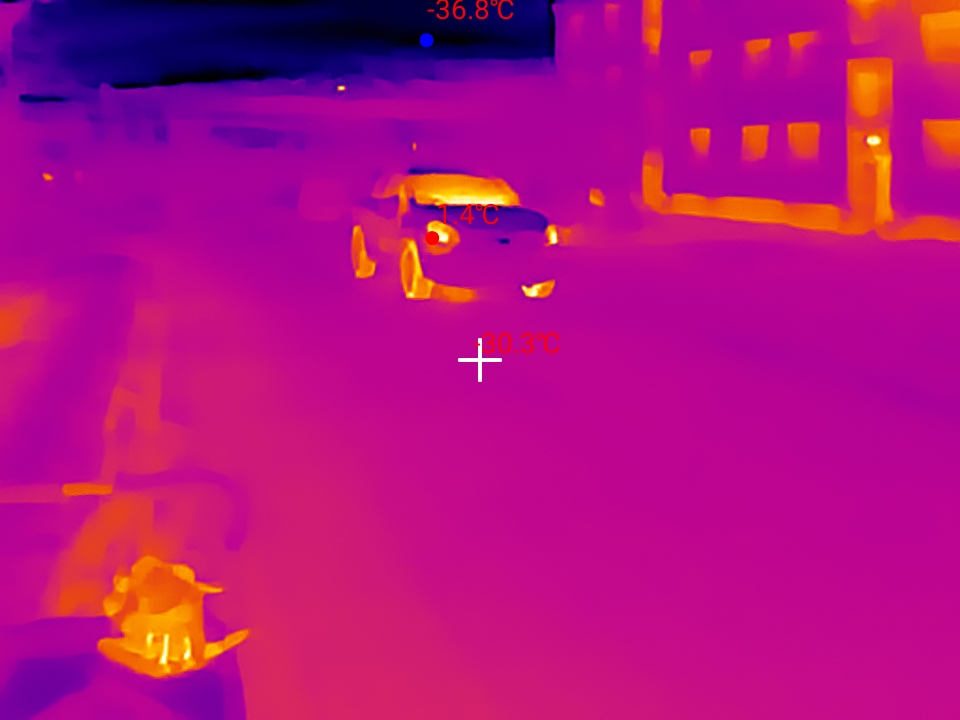
The Illusion of the “All-Seeing Eye”
In the world of modern shooting, the thermal scope is often marketed as the ultimate “God Mode.” We are told that heat signatures cannot hide. However, for those of us living in the “Pyssymiehen Arki” (The Shooter’s Everyday Life) in the Nordics, physics has a way of humbling even the most expensive sensors. Not to mention those, that are available for the average guys.
When the mercury hits -20 C and the wind starts to bite, the battlefield of photons and infrared radiation changes. The question isn’t just about “seeing”; it’s about identification and reliability.
1. The “Harakka” Problem: When Insulation Wins
One of the most striking limitations of thermal imaging is high-efficiency organic insulation. Take a magpie (Harakka) sitting in a tree at -20 C about 10 meters away. A bird’s feathers are a masterpiece of thermal engineering. They trap air so effectively that the surface temperature of the feathers can be nearly identical to the ambient air.
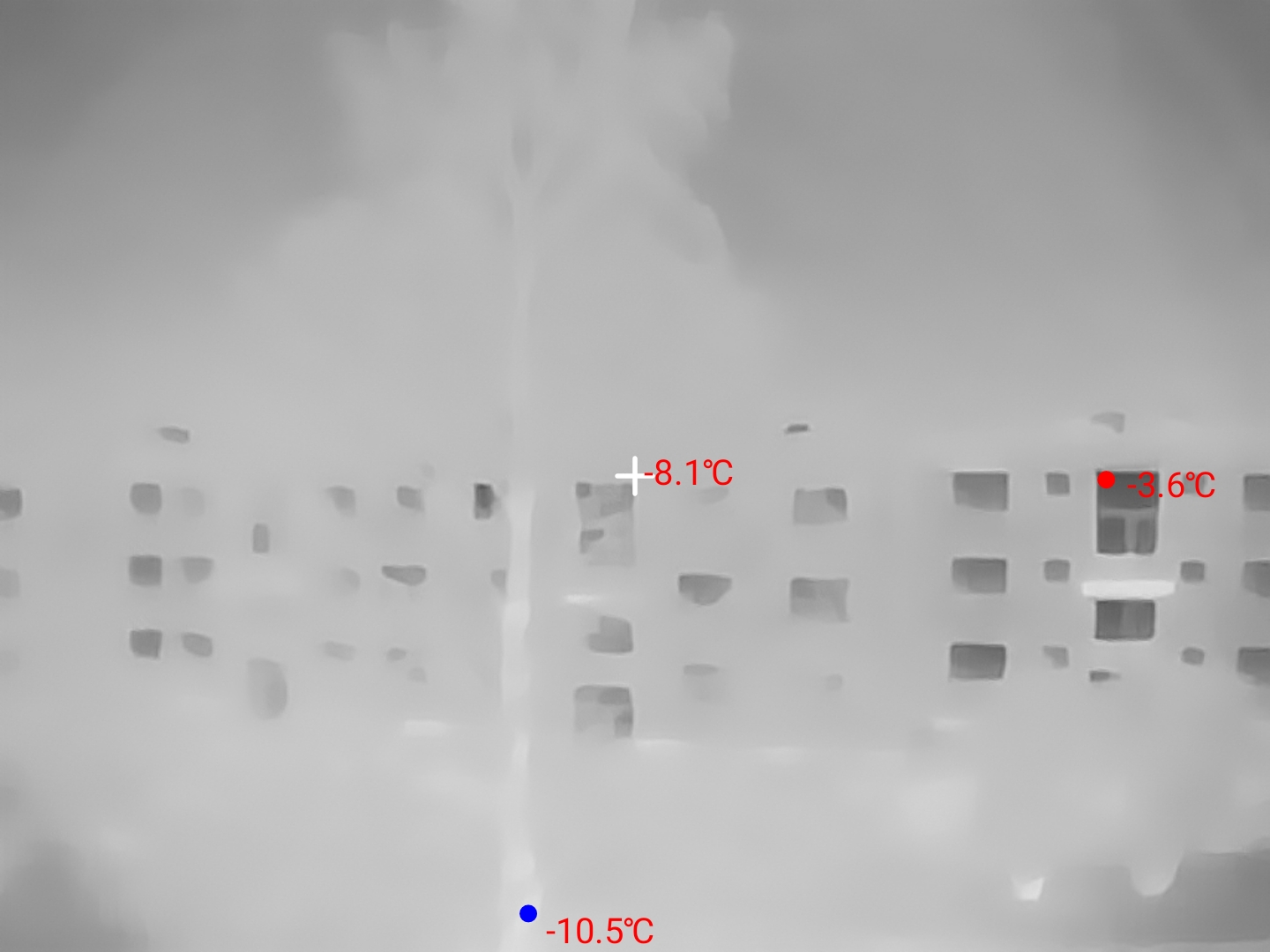
In my reference captures with mobile-based thermal sensors, a bird in a tree can practically vanish. If the sensor’s NETD (Noise Equivalent Temperature Difference) isn’t low enough (meaning it isn’t sensitive enough to detect sub-degree differences), you aren’t looking at a bird; you are looking at a grey smudge that looks exactly like a frozen branch.
This is where the argument for Digital Night Vision (NV), like the Holosun DRS-NV, begins. NV doesn’t care about heat; it cares about reflected light. In a scenario where a target is perfectly insulated, a valonvahvistin (light amplifier) will show you the physical shape, the feathers, and the silhouette that the thermal sensor missed.
2. The Baby in the Snow: The Challenge of Modern Gear
It isn’t just animals. Look at the thermal profile of a baby sleeping, (Yes that IS a thing here), in a high-end winter sleeping bag. The sensor might register a hot spot at the face 36.3 C, but the rest of the body—wrapped in technical layers—registers at about -17C. And I’d like to point out without ANY condieration of redusing the thermal signature. So one more layer for isaulation, say snipers weil, that is not in contact with teh body, this would all but disappear.
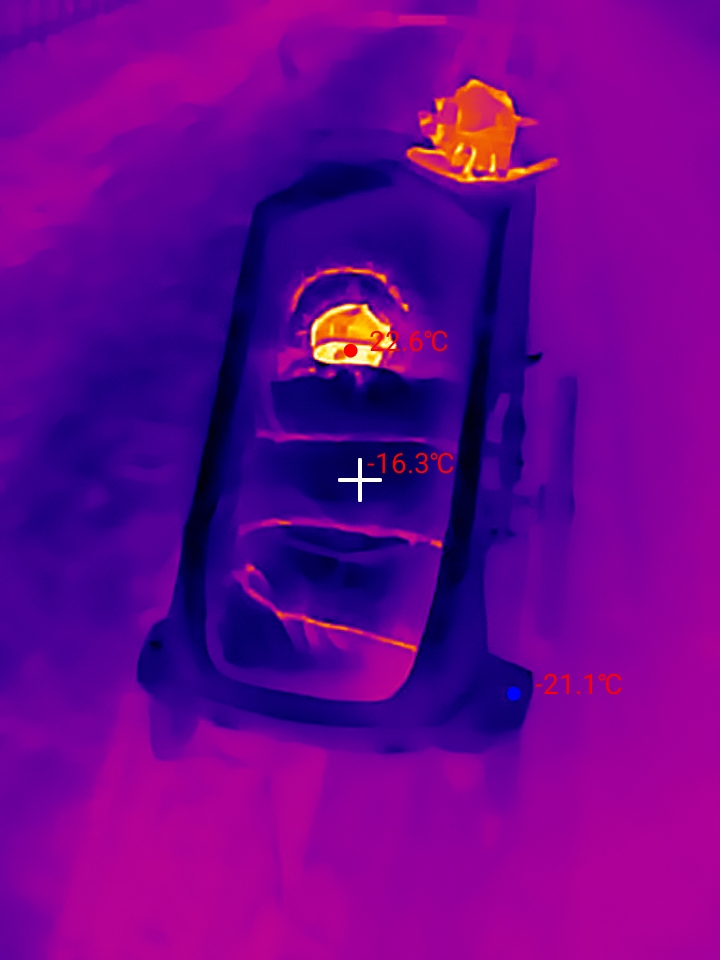
For a hunter or a tactical shooter, this “thermal masking” by clothing is a major hurdle. If a target is wearing heavy wool or modern IRR-treated winter gear, the “glow” that we see in YouTube promo videos disappears. You are left hunting for a “face-only” signature, which is incredibly difficult to spot in dense brush. And if the other guy takes pains of having a balaclava and some mesh, you can hardly see thet either.
3. Refresh Rate (Hz): The Speed of Reality
If you are using a 9Hz or 25Hz thermal “dongle,” you aren’t seeing reality; you are seeing a slideshow of the past. In a dynamic shooting situation, a low refresh rate is a liability.
- The Lag: If a wild boar or a pest animal moves at 5 m/s, a low-Hz sensor will show the heat signature trailing behind the actual physical location.
- The 50Hz Standard: High-end units like the Holosun DRS-TH claim a 50Hz refresh rate. This is the “Gold Standard.” It allows for a fluid, real-time lead on moving targets. Without this, you are just guessing where to aim. Yes this is basically the same thing as computergames FPS, frames per second, rate. You don’t want to go below 60. Which transfers quite nicely into Hz numer.
4. The Digital Fusion: Why Holosun’s DRS is Interesting
The reason the Holosun DRS (Digital Reflex Sight) series is currently the talk of the industry—even without us having hands-on time—is the Hybrid Philosophy.
Most thermal scopes are “digital-only.” If the battery dies, the screen goes black. You are blind. The DRS series is a Red Dot first. You have a physical glass window and a permanent reticle. The thermal (TH) or night vision (NV) is an overlay.
- DRS-TH (Thermal): Best for detecting life. Even if insulated, something usually leaks. It’s your “search” tool.
- DRS-NV (Night Vision): Best for identifying life. Is it a stray dog or a raccoon dog? Is it a neighbor or a threat? The 1080p digital NV sensor provides the visual detail that heat maps lack.
5. Technical Comparison: Why One Isn’t Enough
| Feature | Digital NV (e.g., DRS-NV) | Thermal (e.g., DRS-TH) |
| Glass/Windows | Can see through glass. | Blocked by glass. |
| Identification | High (shows fur/fabric textures). | Low (shows heat blobs). |
| Detection | Depends on IR illumination. | Passive (picks up heat at km range). |
| Insulation | Not affected. | Heavily affected (the “Harakka” effect). |
Final Thoughts: Is Thermal the “Only Right” Gear?
The short answer is: No. Thermal is an incredible tool for detection, but the Finnish winter proves its limits every single day. The “Harakka” in the tree and the “insulated target” are real-world problems that thermal alone struggles to solve.
The future belongs to Fusion. The ability to toggle between a thermal overlay for detection and a high-resolution digital NV for identification—all while having a fail-safe optical red dot—is the holy grail of “Pyssymiehen Arki.”
We hope to get these units on the range soon to see if Holosun’s 50 Hz OLED displays can truly bridge the gap between “detecting a blob” and “making a precise shot” in the freezing dark.
What do you think? Would you trust a thermal sensor alone in -25 c, or do you still want a light amplifier in your kit? Let us know in the comments.
I have added a buyers checklist after the Finnish summary.
Summa Summarum: Lämpö vs. Valonvahvistus Suomen talvessa
Vaikka lämpötähtäintä pidetään usein pimeätoiminnan kuninkaana, tekninen analyysi ja käytännön kokemus pakkasolosuhteista paljastavat merkittäviä rajoitteita:
- Fysiikan rajat: Lämpökamera ei ole röntgenlaite. Jos kohde on eristetty erinomaisesti (kuten harakan höyhenpeite tai laadukas talvivarustus), sen pintalämpötila sulautuu ympäristöön. Tällöin kohde “katoaa” lämpökamerasta.
- Tunnistaminen vs. havainnointi: Lämpökamera on ylivertainen kohteen löytämiseen (havaitset lämpöpisteen kilometrien päästä), mutta valonvahvistin tai digitaalinen yönäkö on usein parempi kohteen tarkkaan tunnistamiseen ja yksityiskohtien näkemiseen.
- Päivitysnopeuden merkitys: 50Hz virkistystaajuus (kuten Holosun DRS-sarjassa) on välttämättömyys liikkuvaan maaliin ammuttaessa. Halvemmat 9–25Hz laitteet jättävät kuvan “laahaamaan”, mikä tekee eettisestä laukauksesta vaikean.
- Hybriditeknologia (Fusion): Holosunin DRS-sarjan kaltaiset laitteet, jotka yhdistävät perinteisen punapisteen ja digitaalisen overlay-kuvan, tarjoavat parhaan toimintavarmuuden. Jos elektroniikka pettää, optinen punapiste on edelleen käytettävissä.
- Lasin läpi näkeminen: Digitaalinen yönäkö (NV) näkee lasin läpi, lämpökamera (TH) ei. Tämä on kriittinen tekijä esimerkiksi ajoneuvosta tai kytiskopista havainnoitaessa.
Lopputulema: Optimaalisessa tilanteessa molemmat tekniikat tukevat toisiaan. Lämpökuva löytää elämän, mutta valonvahvistin varmistaa, mitä olet ampumassa.
Ostajan muistilista: Lämpö vai Yönäkö?
- Metsästätkö pääasiassa kytiskopista tai autosta?
- Valitse Digitaalinen NV (kuten DRS-NV), sillä lämpökamera ei näe lasin läpi.
- Onko ensisijainen tavoitteesi löytää kohde nopeasti laajasta maastosta?
- Valitse Lämpötähtäin (kuten DRS-TH). Se paljastaa elävän kohteen, vaikka se olisi osittain pusikon suojassa.
- Metsästätkö kovilla pakkasilla (-15°C tai kylmempi)?
- Varmista, että laitteessa on OLED-näyttö (kuten Holosunissa), joka ei hyydy pakkasessa.
- Muista, että paksu turkki tai talvivaatetus voi “kadottaa” lämpöjäljen, jolloin NV-tila on välttämätön tunnistamiseen.
- Aiotko ampua liikkuvaan maaliin?
- Varmista, että päivitysnopeus on vähintään 50Hz. 9-25Hz laitteilla ampuminen on hakuammuntaa.
- Haluatko varmistaa kohteen lajin ja sukupuolen tarkasti?
- Digitaalinen NV tarjoaa luonnollisen kuvan yksityiskohdista, kun taas lämpökuva on usein vain tunnistamaton “lämpöleima”.
Buyer’s Checklist: Thermal or Night Vision?
- Do you mainly hunt from a blind or a vehicle?
- Choose Digital NV (like DRS-NV), as thermal sensors cannot see through glass.
- Is your primary goal to spot targets quickly in vast terrain?
- Choose a Thermal Scope (like DRS-TH). It reveals living targets even when partially obscured by brush.
- Do you hunt in extreme cold (-15°C / 5°F or colder)?
- Ensure the unit has an OLED display (like Holosun), which doesn’t lag or freeze in sub-zero temperatures.
- Are you engaging moving targets?
- Verify a refresh rate of at least 50Hz. Engaging moving game with 9-25Hz units leads to significant lag and missed shots.
- Do you need precise target identification (species/gender)?
- Digital NV provides natural image details, whereas thermal often only shows an unrecognizable “heat blob” especially at distance.

 Epämuodikkaita ajatuksia