
Dont worry, Even though this topic is extremely dear to my Finnish Reserve artillerist cold hard heart, I hope not to succumb to “pale hairy chest thumping” and “my army is better than your army” flamewarring. I hope to explain and maybe expand the horizon how this came about for you my esteemed reader.
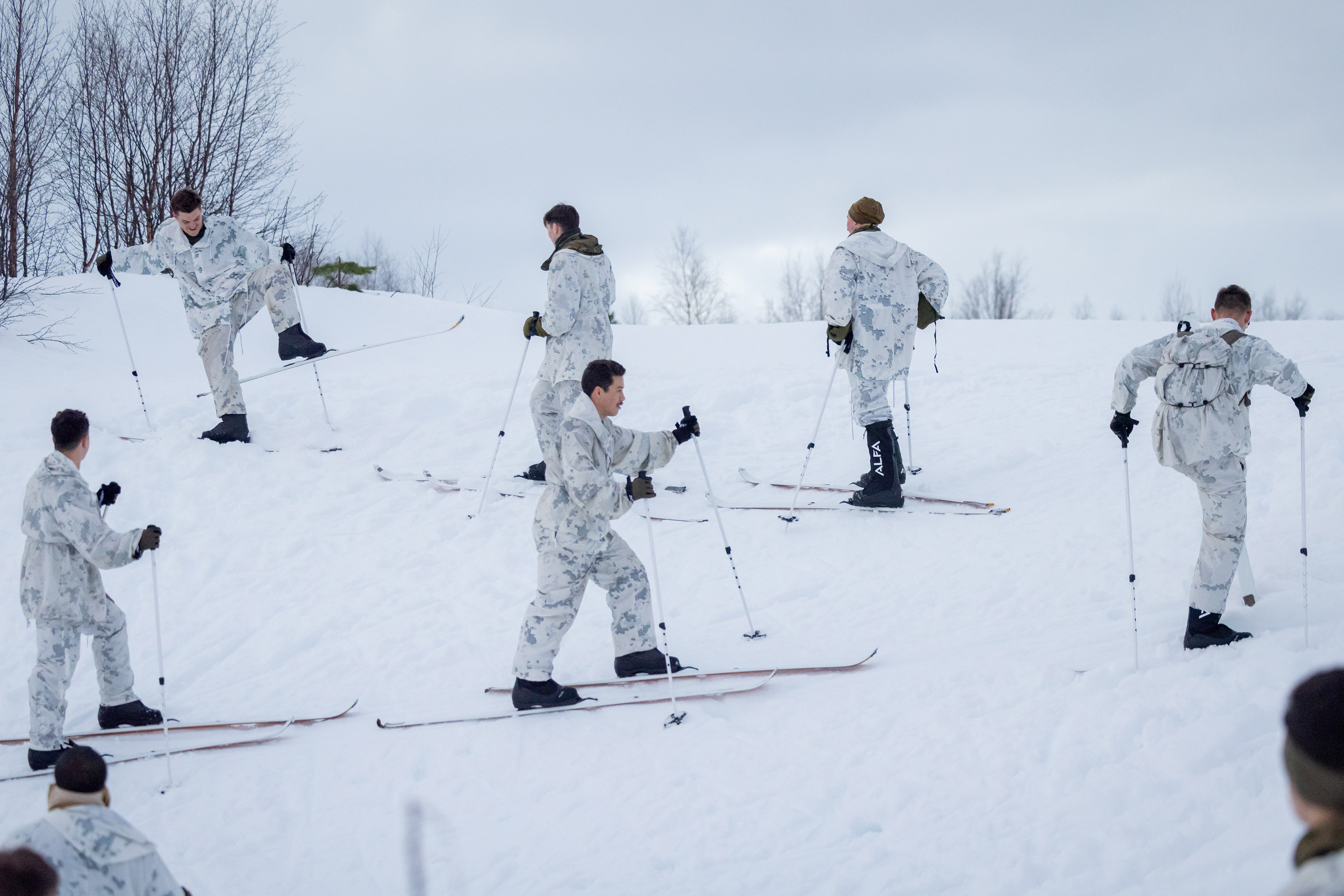
In the sanitized world of modern international relations, military exercises are often treated like high-stakes diplomatic theater. Everyone wears the right patches, says the right things about “interoperability,” and goes home with a certificate of participation. But reality has a nasty habit of intruding when the blank rounds start firing in the Finnish, or in this case Norwegian, woods.
Recently, a scoop by The Times pulled back the curtain on a a revealing discrepancy within the Alliance. During NATO drills, Finnish troops—a mix of conscripts and reservists—reportedly performed with such lethal efficiency that they were asked to “tone it down.” Why? Because their American counterparts, the world’s most well-funded professional soldiers, were beginning to see morale declinein the ranks. And rest assured guys in USMC you are regarded an A and maybe THE A-team here, so I’m almost certain the “varusmiehet ja reserviläiset” in Northern Wiking EX wanted to play their A-game too.
For those who understand the Finnish defense model, this isn’t a surprise. For the rest of the world, it is an unfashionable truth: a citizen-army fighting for its own soil will almost always overcomes a professional force that relies on a manual and a satellite link. One of my friends who acted as a fires commander for a EX battalion against US Army a year or two back commented along lines: “these guys try to fight like they are back at the “sandbox wars” in Irak or maybe Afganistan.” Meaning that the tactics would be suicidal against peer army, who does not run away, when you start to close in. Not unlike Marine magazine yonder explains.
The Times have written what they have, but I really think a great part of the good performance of the “FDF reservists and conscripts team” is in fact the “home field advantage” in wintery high north, In summer, I’d wager, the bets are off. Not even to mention USMC hometurf in, say, San Diego or Parris Island.
If you allow, I shall discuss this a bit more widely from now on. What I do critize somewhat is the satelite antennas tendency to result in micro managing the field, and not giving the leader-on-ground oppourtunity to do is leading. THIS bleeds the adapting away from junior ranks.
The “Viking” Reality Check
The incident reported by The Times centered on the realization that the U.S. Marines and other NATO professionals were being systematically “hunted” by Finnish reservists. In one scenario, the Finnish “opposing force” (OPFOR) didn’t just challenge the Americans; they “disrupted units tactical cohesion”.
The Americans, accustomed to air superiority and total technological dominance, found themselves in a White cold nothingness where their drones couldn’t see through the canopy and their thermal optics were defeated by something as “low-tech” as a spruce branch and a well-placed tarp. When the Finnish commanders were asked to restrain their men, it wasn’t about safety—it was about ego management. If a professional soldier loses every simulated engagement to a 20-year-old conscript from Oulu, institutional expectations are challenged, and the aura of technological superpower begins to evaporate.
Not to mention cold killing batteries and making electronics malfuntion. FDF has been preparing to fight overwhelming force since 1945, so countering surveillance and dispercing has been the name of the game all along. Like Zun Tzu says “When you are close, pretend to be far away”
The Myth of the Amateur
The West has become obsessed with the idea of the “professional soldier”—a careerist who treats war as a job. Finland, stubbornly conservative in its approach, has stuck to the “Invisible Reserve.” or a “Citizen Soldier”.
So The Pro look at Finnish conscripts or reservist they thing of a maybe like a hobbyist. What they miss is the civilian-soldier synergy. In a Finnish squad, the guy carrying the light machine gun might be a mechanical engineer in civilian life. The radio operator might be a telecommunications specialist. The squad leader might manage a construction site.
When a CV90 infantry fighting vehicle breaks down in the middle of a swamp, the American crew waits for a recovery team and a digital diagnostic tool. The Finnish crew? They fix it with a crowbar, a piece of wire, and sheer “Sisu” because they’ve been fixing tractors in the sub-zero dark since they were twelve. This isn’t “inclusive” military theory; it’s the cold reality of a nation that knows no one is coming to save them if they don’t save themselves. Truly victorious are those who help themselves.
This brings into mind one anecdote from 1989 when I was doing my national service. In Reserve Officer school we had an EX. An all terrain tracked vehicle (Of the articulated kind) slid sideways on big pinetree so that the pine was the in the joint. The resident NCO looked the officer cadets looking at the situation, the said to cadet in charge and uttered “There is nothing you can do. What do you do?” So try to help yourself and and all will be easier.
The “God of War” and the 60-Second Window
While the infantry wins the anecdotes, the artillery wins the war. It is a well-known, if uncomfortable, fact in NATO circles that Finland possesses the most formidable “God of War” (Artillery) in Western Europe.
There is an anecdote often told by NATO observers: In many Western armies, the process of identifying a target, relaying it to headquarters, clearing the “rules of engagement,” and finally firing can take several minutes. In Finland, the system is decentralized and lethal. From the moment a Finnish forward observer (one in every platoon) sees a target to the moment 155mm steel starts raining down is often less than 60 seconds. (Considering flight times obviously.)
During one exercise, a British officer reportedly remarked that the Finnish artillery didn’t seem to follow a “process”—it seemed to respond like a reflex. This is what happens when you don’t waste time on corporate-style management layers in your chain of command. You find the enemy, and you rain “heavenly wrath” upon them.
If you please indulge me while I ramble on a bit about the artillery system in Finland. (As it is my branch) Yes the park is rather large, but so is the amount of artillery battallions in a brigade. Basic Finnish brigade has four infantry battallions, and an Artillery regiment plus an independent artillery battallion. Artillery battallions are called “Patteristo”. It is basically plurar of battery, “patteri”. Thus basically every batallion has a patteristo to support it. This is the brigade commanders personal big hammer. As this bleeds down in inf. batallion the most exposed company gets the right of way to patteristo, the second company has the use of battalions 120mm Mortar company, and the last one has to make do with her integral 82mm mortar platoon.
But if it so happens that intelligence staff assessed wrong and it is the third company that need some heavyhanded assistance, you just give them right of way, and there you go.
Main point in the volume of fire is that FDF arty systems fires patteristo 18 weapons to targets, so there is a big difference from other NATO countries (usually a 8-12 gun battery firing) volumes of fire. The 155mm HE shell is exactly the same as anyone elses.
In forested terrain distances of engagement are quite close, so response times need to be speedy, time to “fire for effect” needs to be minimum. Targets tend to run away.
“They Are Like Ghosts”
Anecdotes from the Cold Response and Viking exercises paint a spooky picture for our allies. One U.S. Marine sergeant described the frustration of “fighting ghosts.” His unit was equipped with the latest night-vision and thermal tech, yet they were ambushed by Finnish scouts who had moved kilometers through deep snow on skis—silent, invisible, and completely off the grid.
This is what “Raate Road” teaches us. With skis you are free to move and even quite a bit faster than on foot during summer, which gives you advantage to choose the place of fight. You can prepare that and inflict high casualties to more road bound adversaries.
The Finnish soldier doesn’t fight the environment; he uses it as a force multiplier. While NATO allies spend 70% of their energy just trying to stay warm and “survive” the Arctic conditions, the Finn is already “at home.” To the Finn, -20°C isn’t a crisis; it’s a tactical advantage. You don’t need a $100,000 sensor if you know how to read the snap of a twig or the way the snow settles.
There is now secret concotion to drink. That is living in high north. I’m sure that given climatization time and guidance almost everybody can do this. I’m quite sure that any Alaskan infantryman, can tell you the same. As a personal note, my wife who is born in Kenya was quite distraught sometimes in her first winter here, but nowadays she just puts a pair of long johns under the jeans like everybody else, and thinks nothing of it.
The Unfashionable Conclusion
Finland’s military isn’t built for “expeditionary warfare” in far-off deserts. It is a grim, focused, and nationalistic machine designed for one thing: making the cost of invasion higher than any rational adversary is willing to pay.
The Finnish Defence Forces are not organised around representational targets or career incentives, but around unit survival and performance. Universal service and the absence of educational exemptions mean that leadership credibility is earned vertically, not imported horizontally.
Officers and NCOs are not socially distinct from their soldiers; they are simply the same cohort, selected earlier and trained longer. This reduces internal friction and makes preferential treatment both visible and corrosive—something units instinctively resist.
The “Invisible Reserve” is a nightmare for professionals because it proves that technology cannot replace cold national will and local mastery. I’m quite sure that those same conscripts and reservist would have had a extremely hard time in, say San Diego because of the oppressive heat, and no spruce branches to mask their passing. So really I think a great part of the good performance is the “home field advantage” in wintery high north, In summer, I’d wager, the bets are off.
Reference & Source Material
- The Times (London): “The Finnish soldiers who made US troops lose heart” – The primary scoop detailing the disparity in performance during Nordic exercises.
- Marine Corps Gazette: Various articles on “Lessons from the North,” where USMC officers admit that standard American doctrine fails in the Finnish environment.
- IISS (International Institute for Strategic Studies): Data confirming Finland’s artillery superiority in Western Europe (The Military Balance).
- Royal United Services Institute (RUSI): Analyses on the “Finnish Model” of total defense and its effectiveness compared to smaller, professional European armies.
- Corporal Frisk (Military Blog): A reliable source for deep-dives into Finnish tactical performance and exercise feedback from a Nordic perspective.

 Epämuodikkaita ajatuksia