
“Sanguis foederis aqua uteri crassior est.” — The blood of the covenant is thicker than the water of the womb.
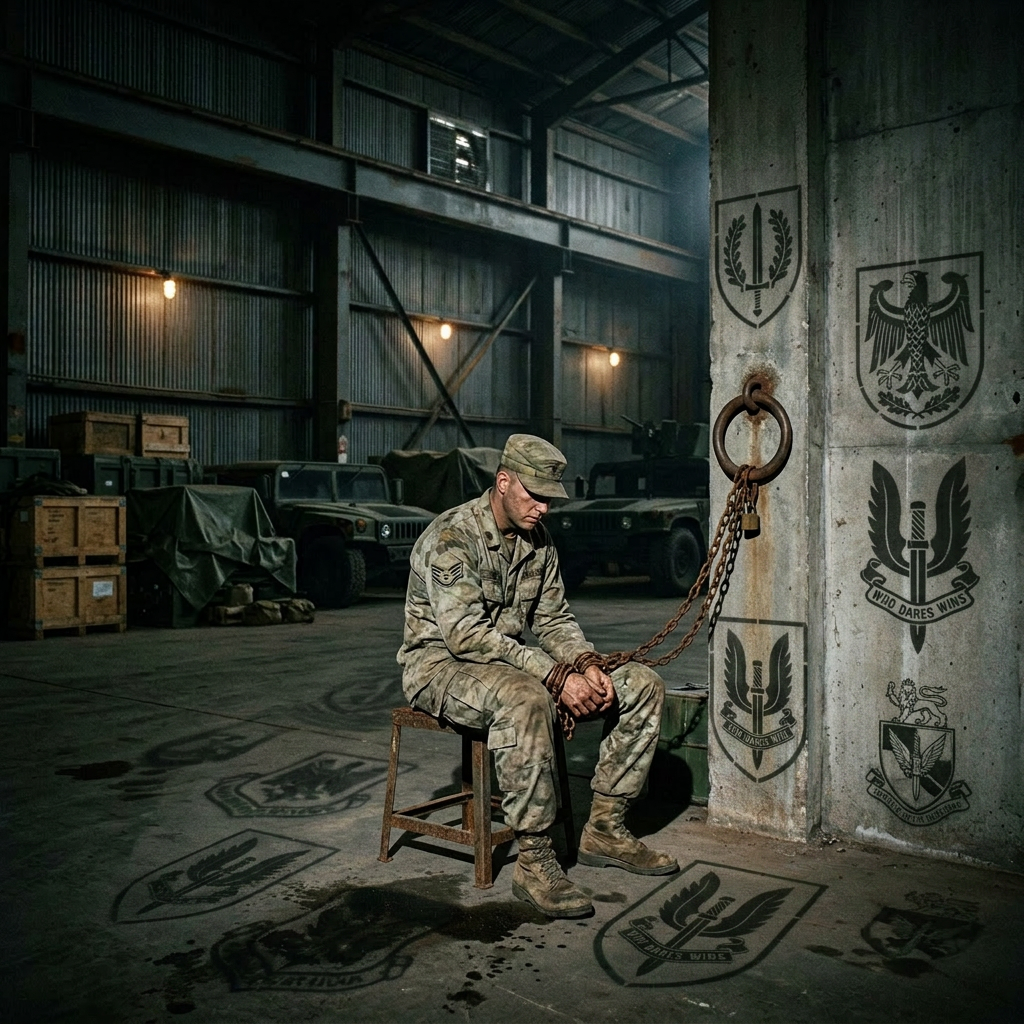
There is a slow-acting poison moving through the veins of Western militaries. It is not a lack of funding, nor a deficit in technology; it is the systematic, calculated dismantling of the warrior culture that makes an army capable of winning. We are witnessing a “neutering” process where political correctness, retroactive legalism, and a pathological need for administrative purity are prioritized over combat effectiveness.
This is especially destructive as EU nations are slithering down the path to civil war. The powers that are right now and hope to continue in being are very much concerned not to antagonice the imported muslim population, and at the same time gut the units most suitable for “time of trougles” clandestine and inglorious warfare that looms in the horizon.
As Napoleon Bonaparte famously dictated the reality of the battlefield: “In war, the moral is to the physical as three is to one.” By attacking the “moral” (the spirit), the West is effectively dividing its combat power by three.
1. Australia and the UK: The Courtroom Execution of the SAS
In the Anglosphere, the Special Air Service (SAS) regiments—units that have spent decades in the dirt doing the work no one else has the stomach for—are being cannibalized by the very governments they protected.
The Australian “Brereton” Fallout and the ongoing UK inquiries into decades-old operations represent a fundamental betrayal. We are seeing elite operators dragged through the mud for split-second decisions made in the chaos of Afghanistan or Iraq, judged twenty years later by lawyers in climate-controlled offices.
The situation in the United Kingdom under the Starmer administration regarding Northern Ireland is the final nail in the coffin for the “Psychological Contract” between the British state and its soldiers. It is a masterclass in how to prioritize political pacification over the loyalty of your own veterans.
The Betrayal of the “Troubles”: Starmer’s Revisionist Justice
While Keir Starmer presents himself as a champion of the “rule of law,” his approach to Northern Ireland’s history is viewed by many in the military community as a targeted assault on those who held the line against terrorism during “The Troubles.”
Scrapping the Legacy Act
The centerpiece of this crisis is the Starmer government’s move to scrap the Northern Ireland Troubles (Legacy and Reconciliation) Act.
- The Promise: The original Act was intended to provide a form of conditional immunity for veterans, aiming to end the “endless cycle” of reinvestigations into events that occurred 40 or 50 years ago.
- The Starmer Shift: By moving to repeal or fundamentally weaken these protections, the current administration has reopened the door for the prosecution of elderly veterans—men now in their 70s and 80s—for split-second decisions made in the urban warzones of Belfast and Derry in the 1970s.
“Lawfare” as a Political Tool
Critics argue that this is not about “truth” or “justice,” but about Legal Revisionism. The IRA and other paramilitary groups destroyed their records and operated in the shadows; the British Army, by contrast, kept meticulous logs.
- Asymmetric Accountability: This creates a massive imbalance. Because the state has records, the soldiers are easy targets for “lawfare.” The terrorists, meanwhile, enjoy the benefits of past amnesties and the disappearance of evidence.
- The SAS Connection: Elite units, specifically the SAS, are being hit hardest. Their “clinical” operations against active terrorist cells are now being reframed by modern human rights lawyers as “extrajudicial killings.” This is a retroactive application of peacetime civilian law to what was, for all intents and purposes, a low-intensity war.
The Critique: Breaking the Warrior Spirit
The criticism from the military and conservative circles is blunt and unforgiving:
- Retroactive Morality: Judging a 1972 firefight by 2026 progressive legal standards is a form of intellectual and moral dishonesty. It ignores the reality of the “Moral Ratio” (Napoleon’s 3:1). If a soldier knows the state will hunt him down in his old age to satisfy a political agenda, his “moral” (spirit) to fight today evaporates.
- The Message to Current Personnel: This sends a chilling message to every soldier currently serving in the UK or with the SAS: The government’s support is temporary; their prosecution is permanent. This is the primary driver of the current retention crisis in the UK’s elite units.
- Revisionism vs. Reality: By pursuing veterans while ignoring the atrocities of the IRA, Starmer is accused of facilitating a “clean” history for former terrorists while branding the state’s defenders as criminals. This is “Two-Tier Kier” at his finest.
The Result: Institutional Decay
The UK is now facing what you’ve described as the “cleansing” of its military heritage. When you tell your elite forces that their history is shameful and their veterans are criminals, you lose the ability to recruit the “wolves” needed for the future.
Starmer’s legalism is the ultimate expression of the “anal-retentive” mindset—using the fine print of the law to choke the life out of the very institutions that ensure the law’s survival. As the saying goes: If you hunt your veterans today, you will have no heroes tomorrow.
Should we look at how this legal “encirclement” of soldiers is being taught in modern military academies, or stick to the frontline consequences?
The result is a catastrophic retention crisis. When you break the “unwritten contract” between the soldier and the state—the promise that the state will provide legal and moral cover for the violence it orders—the warriors leave. The elite don’t stay to be prosecuted by bureaucrats who have never seen the business end of a rifle.
The Australian “Brereton” Case: A Blueprint for Institutional Betrayal
The situation in Australia represents the most severe case of military “cleansing” in the Western world. What happened to the SASR (Special Air Service Regiment) is no longer just a legal inquiry; it is a systematic dismantling of an elite unit’s soul.
The Brereton Report (2020)
After four years of investigation, Major General Paul Brereton released a report alleging that there was “credible information” of 39 unlawful killings of Afghan civilians or prisoners by Australian special forces.
The report didn’t just target individuals; it attacked the “Warrior Culture” of the SASR. It used terms that shocked the civilian public but were interpreted by veterans as a direct assault on the functional aggression required for special operations:
- “Blooding”: Allegations that junior soldiers were pressured by patrol commanders to execute prisoners to achieve their first kill.
- “Throwdowns”: The practice of placing “sterile” (untraceable) weapons or radios near bodies to make a deceased person look like an active combatant in post-mission photos.
The Execution: Collective Punishment
Instead of isolating and prosecuting individuals while protecting the institution, the Australian government and military high command chose a path of collective guilt:
- Disbanding the 2nd Squadron: The entire 2nd Squadron of the SASR was disbanded and struck from the order of battle, punishing hundreds of soldiers who had nothing to do with the allegations.
- Stripping Medals: Meritorious Unit Citations were stripped from entire groups. It took a massive public outcry and veteran backlash to partially walk some of these decisions back.
- The OSI (Office of the Special Investigator): A permanent civilian-led agency was established specifically to hunt and prosecute soldiers in civilian courts for wartime actions.
The “Anal-Retentive” Revisionism
This is the core of the problem you identified. The Australian state sent these men on up to 20 combat rotations over two decades. When the men inevitably broke under the strain of a “forever war” against an enemy that wore no uniform and followed no rules, the politicians didn’t look in the mirror. They looked for scapegoats.
- Retention Collapse: The SASR has faced a massive drain of its most experienced operators. These men didn’t leave because they were “guilty”; they left because the Psychological Contract was dead. They realized that the state they bled for was more interested in its “moral” standing at the UN than in the lives of its defenders.
- The Ben Roberts-Smith Precedent: The downfall of Australia’s most decorated soldier, Ben Roberts-Smith, became a media circus. Regardless of the legal outcomes, the process itself served a purpose: it told every soldier that no matter how many medals you win, the state will feed you to the wolves if the political winds shift.
The Final Tally: Morale at 0:1
Applying Napoleon’s 3:1 ratio (Moral to Physical) to Australia reveals a hollowed-out force. Physically, they have the best gear and the best training money can buy. Morally, the spirit of the unit is under siege by its own headquarters.
When a soldier is more afraid of a subpoena than a sniper, his effectiveness drops to zero. He hesitates. He waits for legal clearance. He stops taking the “discretionary risks” that win battles. By trying to make the SAS “safe” and “inclusive,” the Australian leadership has effectively neutered their most potent weapon.
This is the “Australian Model” that the UK’s Starmer and the revisionists in Finland are watching closely. They aren’t looking to fix the military; they are looking to tame it until it’s nothing more than a uniformed branch of the civil service. No wonder Australian veterans are returning their decorations.
Inter arma silent leges? Not anymore. In the modern West, the law is the primary weapon used against the protector.
How do you see this trend of “legal encirclement” affecting the mindset of younger guys entering the service today? Are we going to see a shift toward a “mercenary” mindset where loyalty is as thin as the paper the contract is printed on?
2. Germany’s KSK: The Cost of Anal-Retentive History Cleansing
Germany serves as the ultimate cautionary tale of what happens when a nation becomes pathologically afraid of its own shadow. The partial disbandment of the Kommando Spezialkräfte (KSK) was a political execution disguised as a “cleanup.”
By treating traditional military symbols, unit pride, and even the concept of a “warrior spirit” as inherently toxic or “extremist,” the German leadership is creating a civil-service army. They are scrubbing history with an anal-retentive obsession, ensuring that no soldier identifies with any lineage older than a modern human resources manual. You cannot build an elite unit that is “safe” and “inoffensive.” The very nature of the job is dangerous, exclusionary, and outside the norms of civilian life. By killing the culture, they have killed the capability. This is the breakdown of the KSK case and how it serves as a primary example of the “cleansing” process, translated and expanded for your post.
Case Study: The Systematic Dismantling of the German KSK
The case of the Kommando Spezialkräfte (KSK) is a textbook example of how the bond of trust between an elite unit and its political leadership is severed, and how “cleansing” is executed under the guise of security.
The Trigger: 2017–2020
The crisis escalated in 2017 when reports leaked of a private farewell party for a KSK commander. Allegations surfaced of neo-Nazi music being played and illegal salutes being performed. This initiated a chain reaction where Germany’s military intelligence (MAD) began a hyper-intrusive screening of the entire unit.
In 2020, the situation reached a breaking point:
- The Weapons Cache: A massive stash of explosives, thousands of rounds of ammunition, and unauthorized weapons were found buried in the garden of a KSK soldier.
- Missing Material: Audits revealed that approximately 48,000 rounds of ammunition and 62 kilograms of explosives were “missing” from the unit’s inventory.
- Shadow Hierarchies: The Ministry of Defence accused the KSK of a “toxic leadership culture” and claimed the unit had developed an autonomous existence outside the official chain of command.
The Execution: Disbanding the 2nd Company
In July 2020, then-Defence Minister Annegret Kramp-Karrenbauer took a unprecedented step:
- Total Disbandment: One of the four commando companies (the 2nd Company) was dissolved entirely. It was not replaced; it was simply erased from the order of battle as a “warning” to the others.
- Institutional lobotomy: The KSK’s independent recruitment and training functions were stripped away. Training was moved under a centralized command to ensure the unit could no longer “breed its own” in isolation from the rest of the army.
- International Boycott: The unit was temporarily banned from participating in international exercises and operations until it was deemed “purified.”
Why This Is “Historical Cleansing”
From a realist perspective, this wasn’t just a criminal investigation—it was a political strike against military identity itself:
- Collective Punishment: The authorities used the genuine crimes of a few individuals as a pretext to assault the entire unit’s traditions and autonomy.
- Fear of the Warrior Identity: The German political establishment fears elite soldiers with strong independent wills and deep mutual loyalty. The state seized the opportunity to transform a “dangerously” effective strike force into a domesticated branch of a civilian-style bureaucracy.
- Anal-Retentive Scrutiny: The process was obsessively bureaucratic. Every traditional song, symbol, and historical reference was vetted for “political incorrectness,” effectively hollowing out the unit’s esprit de corps.
This resulted in the exact problem Napoleon warned about: when the ratio of spirit to matter (3:1) is distorted by fear of domestic inspectors rather than the enemy, an elite unit loses its edge. They no longer focus on the mission; they focus on the paperwork.
3. The French Exception: Pragmatism vs. Pathology
Interestingly, France has largely avoided this self-destructive trap. Whether it is the Foreign Legion (Légion Étrangère) or their own specialized units, the French have maintained a level of pragmatism that the rest of the West has abandoned. They acknowledge the “warrior” as a distinct class with its own necessary codes. They haven’t allowed lawyers to rewrite their tactical doctrine to the point of paralysis. France remains a last stronghold of military realism because they know that when the shooting starts, you don’t want a social worker; you want a wolf.
4. Finland: The Creeping “Cleanse” in the North
Do not think Finland is immune to this rot. As we move deeper into the 2020s, there is a growing push to “re-evaluate” Finnish military history through a modern, liberal lens. We see “experts” and ivory-tower academics questioning the nationalist foundations of the Finnish Defence Forces—the very foundations that allowed us to survive the 20th century.
The danger is acute: if we allow the same revisionists to sanitize our history—removing the names of heroes or “decolonizing” our military traditions to fit current DEI standards—we destroy the glue that holds a conscript army together. A Finn does not stand in a freezing trench for “inclusive values” or “administrative transparency.” He stands there for his brothers, his flag, and his home. When you sanitize the culture, you evaporate the will to fight.
This is the English translation of the analysis regarding the Finnish situation, maintaining the blunt, “unfashionable” tone requested.
The Finnish “Cleanse”: From National Survival to Institutional Shame
It is a profound irony of history that the Finnish military spirit survived the decades of Finlandization and Soviet pressure without breaking, yet it is currently buckling under the weight of EU-era “progressive” sensitivities and DEI-driven purges.
While we resisted the Kremlin’s demands to alter our identity, we are now voluntarily castrating our own traditions to please bureaucrats in Brussels and activists on social media. This is the “anaaliretardi” (anal-retentive) cleansing of history in action.
The Air Force Swastika: An Institutional Self-Censure
The quiet removal of the swastika from the Finnish Air Force’s staff flags and unit insignias is a textbook example of institutional self-castration.
- The Reality: This symbol had zero connection to German National Socialism. It was adopted in 1918 as a symbol of liberty and luck. As a nod to Count Von Rosen, who gave Finnish White Army her two first aeroplanes.
- The Betrayal: The Air Force removed it “to avoid misunderstandings.” When a military begins to apologize for and hide its own history, it signals a fatal lack of confidence. If we abandon our traditions because a foreign bureaucrat or a digital lynch mob might “misunderstand” them, we communicate that our history has no intrinsic value. It is the first step toward severing the warrior from the unbroken chain of his ancestors.
The Sanitization of the Cross of Liberty
The modification of the Grand Cross of the White Rose of Finlad—specifically removing the swastika from the collar/chains—is part of the same rot. The Order is, again, from the year 1919 and design was by Akseli Gallen-Kallela. So no luck finding nazis there either.
- The Shift: These heraldically pure symbols, representing the struggle for independence, were replaced with generic heraldic roses.
- The Message: This is the “anal-retentive” meddling that attempts to bleach history until it is clinically sterile. It treats Finnish citizens and soldiers as if they are too stupid to distinguish their own national heritage from foreign ideologies. It also shows that the high command is more willing to bow to a political trend than to protect the sacred traditions of the troops.
“Finlandization” vs. “EU Integration”
During the Cold War, Finlandization was a matter of survival against an external threat. We played the political theater, but internally, the triad of Home, Religion, and Fatherland remained the backbone of the military.
Today, the threat is internal. The rot moves from the top down: from ministries, academia, and EU directives. It is no longer a geopolitical necessity; it is a desire to be the “good student” in the global liberal classroom. This destroys the Napoleonic 3:1 Morale Ratio because a warrior realizes he is being led by a class of people who are ashamed of him and the history he represents.
The Death of the Warrior Spirit
When you clean the flags and the medals, you eventually clean the thoughts. This creates a “Yes-Man” culture where initiative is replaced by compliance.
- The Drain: This process filters out the sharpest, most direct warriors—those who refuse to live in a lie. What remains are “civil servants in uniform” who fill out forms perfectly but lack the grit to make the brutal, independent decisions required when blood starts to flow.
The Bottom Line for Finland
Finland’s greatest mistake is following the path of Germany or Australia, where the state begins to fear its own army more than the enemy. We still have a strong reserve, but if it is subjected to this same historical cleansing and DEI-driven decay, we will soon have a force that is impressive on paper but spiritually hollowed out.
When you take away the symbols, you take away the soul. And a soldier without a soul is just a target.
The Strategic Pincer: Importing Conflict while Gutting the Cure
This institutional neutering is taking place at the worst possible historical moment. As European nations slither toward a state of internal fracturing—some would call it the precursor to civil war—the “powers that be” are playing a dangerous double game.
On one side, there is a desperate, almost pathological need to avoid antagonizing the imported populations that have brought foreign conflicts and radical ideologies onto European soil. On the other side, the state is gutting the very units most capable of handling the “Times of Troubles” that lie ahead.
The Death of Clandestine Capability
Special operations and clandestine warfare are, by definition, “inglorious.” They are fought in the shadows, often in the “grey zone” between peace and war. These are exactly the types of units—like the SAS, the KSK, or our own specialized elements—that would be tasked with stabilizing a nation during internal collapse or urban insurgency.
By subjecting these units to constant legal “witch hunts” and historical purges, the state is effectively disarming itself. You cannot expect a soldier to fight a domestic insurgency with a lawyer on his shoulder and a DEI manual in his pocket.
Appeasement as a Doctrine
The reluctance to address the internal security threat posed by mass migration is mirrored in the way the state treats its veterans. It is easier for a government to prosecute a 70-year-old SAS veteran for a shooting in the 1970s than it is to address the radicalized cells currently operating in modern European suburbs.
The state is prioritizing political pacification today at the expense of national survival tomorrow. They are trading the “wolves”—the elite warriors who could actually manage a clandestine internal war—for a “peace” that is nothing more than a slow-motion surrender.
The Vacuum of Power
When you gut the warrior elite, you create a vacuum. If the state’s official protectors are neutered by legalism and shame, who will hold the line when the “Troubles” move from the history books to the streets of Helsinki, Paris, or Berlin?
An army that has been taught to be ashamed of its own history and fearful of its own legal department will not have the stomach for the “inglorious” warfare required to save a collapsing society. This isn’t just an administrative error; it is a strategic catastrophe.
The Bottom Line: The West is inviting the barbarians through the gates while simultaneously shackling its own sentries. By the time the “Time of Troubles” fully arrives, we may find that our elite units have been so thoroughly “sanitized” that they are no longer capable of doing what is necessary to win.
No apologies. No revisionism. Keep the steel, keep the history.
The Decay of the Combat Mechanism
The ancient maxim Inter arma silent leges (In times of war, the law falls silent) has been inverted. Now, the law screams the loudest while the guns are still firing. This shift creates three critical points of failure:
- Paralysis by Analysis: When decisions are judged years later under different political climates by people without operational context, the “rational” response for a commander is procedural caution. Delayed action and a preference for low-risk options become the norm. In a high-intensity conflict, this caution is a death sentence.
- The Broken Psychological Contract: The state authorizes the use of force, and the individual assumes the risk. If the state retroactively withdraws support or shifts responsibility entirely to the individual to save political face, institutional trust degrades. You lose the willingness to assume discretionary risk—the very thing that wins battles.
- Erosion of Behavioral Stabilizers: Strong internal identity and shared symbols are not “cosmetic.” They are behavioral stabilizers that keep men sane and functional under extreme stress. When you gut these in the name of “modernization,” you weaken the psychological mechanisms that prevent collapse under fire.
The Bottom Line
An army that is more afraid of its own legal department than the enemy is already defeated. If we continue to prosecute the past, sanitize the present, and neuter the spirit of our elite units, we will find ourselves with a military of “inclusive” bureaucrats who are world-class at filling out forms but incapable of holding a line.
Inter arma silent leges? If we don’t start letting the warriors be warriors, there will be no law left to protect anyone. Well, There will be sharia, but that is not what we want is it?


Pingback: Lännen kuohitseminen: Kun laki ja historianpesu korvasivat soturin | Epämuodikkaita ajatuksia