
On May 19, 2026, aviation history was made in the California desert. A joint project between Sweden’s Saab and General Atomics Aeronautical Systems (GA-ASI) took to the skies for its maiden flight. Named LoyalEye, this system integrates a strategic-level Airborne Early Warning (AEW) radar onto the back of an uncrewed MQ-9B SkyGuardian Medium-Altitude Long-Endurance (MALE) drone.
While mainstream media focuses on the novelty of a “drone AWACS,” let us analyze the technical reality of this platform through the lens of pure engineering logic and physics. The operational boundaries of this contraption are strictly dictated by two factors: available electrical power and electromagnetic physics.
Disclaimer & Methodology
This analysis is based strictly on publicly available specifications regarding the MQ-9B SkyGuardian airframe, propulsion, and standard electrical output. The performance figures regarding Saab’s LoyalEye radar system are informed speculations and educated guesses based on established radar physics, semiconductor efficiency, and power constraints.
1. The Power Bottleneck and Gallium Nitride (GaN) Physics
The MQ-9B SkyGuardian is powered by a reliable Honeywell TPE331-10 turboprop engine delivering approximately 900 shaft horsepower (712 kW). From this mechanical output, the drone’s standard generator system extracts 45 kVA of electrical power. Accounting for system overheads, avionics, and satellite communication (SATCOM) links, the platform may realistically yield around 36–45 kW of continuous electrical power for payload use, but likely less.
Even if we assume an optimized scenario—where the drone is retrofitted with an upgraded generator or a supplementary battery buffer to allocate a flat 60 kW of electrical power exclusively to the radar—this energy must be divided between the two side-looking AESA (Active Electronically Scanned Array) panels. This leaves 30 kW of electrical power per side.
Modern Gallium Nitride (GaN) based AESA radars convert input electrical power into Radio Frequency (RF) transmit power with an efficiency of roughly 30% to 40%. Therefore, the actual peak or average transmit power (P_t) per panel is guestimated to be in the ballpark of 10 kW.
How can a 10 kW uncrewed radar compete with traditional crewed AWACS platforms that operate in the megawatt range? The answer lies in the Radar Equation and the inverse-fourth-power law.
2. The Radar Equation and Detection Performance
A radar’s detection range ($R$) does not degrade with the inverse square of the distance like a normal radio broadcast; it degrades to the fourth power because the signal must travel to the target and reflect back to the receiver.
Because the parameters are locked under a fourth root, massive changes in transmit power do not scale the detection range linearly.
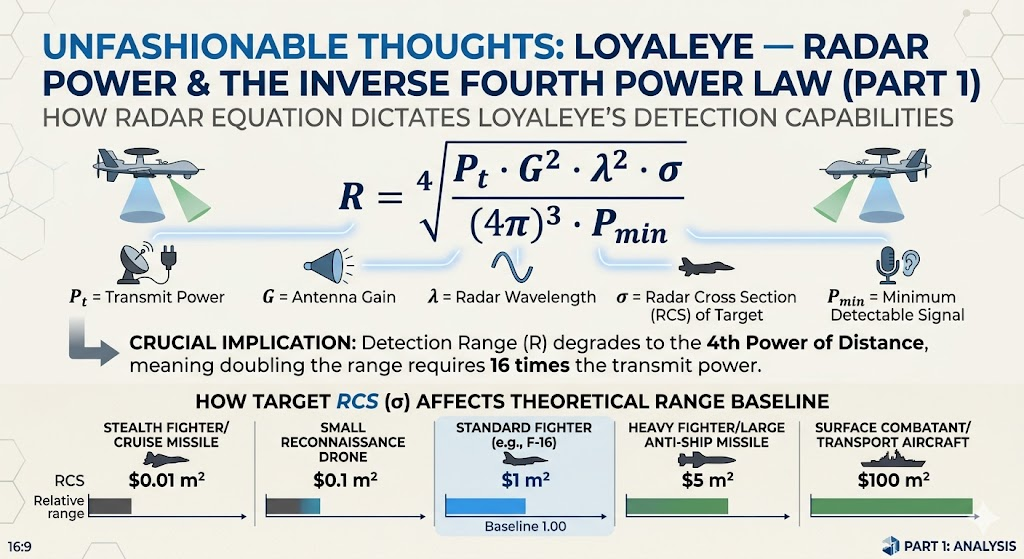
If we establish a baseline detection range against a standard target with a Radar Cross Section (RCS) of 1 m^2 (representing a typical modern non-stealth fighter or cruise missile), physics dictates the following behaviors:
- The Power Halving Paradox: If one panel is deactivated or the allocated power is halved , the detection range does not drop by half. It decreases by a mere 16% . Mathematically, the drone’s strict power limit does not penalize its range as severely as one might intuitively think.
- Target Size Variance: Keeping the radar’s transmit power constant, the detection range varies based on the target’s RCS relative to our 1m^2 baseline:
| Target Type | Typical RCS (σ) | Range Factor (Relative to 1 m2) | Operational Implication |
| Stealth Fighter / Low-RCS Cruise Missile | 0.01 m^2 | approx 0.31 | Detection range drops to 31% of the maximum baseline. |
| Small Reconnaissance Drone | $0.1 m^2 | approx 0.56 | Detection range drops to 56% of the maximum baseline. |
| Standard Fighter (e.g., F-16 / Mig-29) | 1 m^2 | 1.00 | The Baseline Maximum Range. |
| Heavy Fighter / Large Anti-Ship Missile | 5 m^2 | approx 1.50 | Detection range increases by 50%. |
| Surface Combatant / Large Transport Aircraft | 100 m^2 | approx 3.16 | Detection range increases by over 3x (+216%). |
Since the LoyalEye is a side-looking array optimized for a drone flying an edgewise orbit (the classic “racetrack” pattern), the energy is focused entirely to the left and right of the flight path. Eliminating the need for a forward-facing array saves immense amounts of critical electrical power.
3. The Silent Hunter: EMI Mitigation and LPI Capability
One of the most significant—yet least discussed—advantages of this uncrewed configuration is the radical mitigation of internal Electromagnetic Interference (EMI) and the enhancement of Low Probability of Intercept (LPI) characteristics.
Traditional crewed AWACS platforms utilize massive, mechanically rotating rotodomes or large waveguide systems. These create immense electromagnetic noise, stray radiation, and arcs across slip rings. On an uncrewed platform packed to the brim with ultra-sensitive satellite communication (SATCOM) arrays and dual-band GPS/GNSS receivers, that level of internal EMI would be catastrophic.
LoyalEye’s fixed AESA panels are solid-state components with zero moving parts and zero mechanical electrical noise. The RF signal is formed and steered digitally right at the face of the array. This allows for highly advanced LPI (Low Probability of Intercept) operations:
- Suppressed Side Lobes: Energy does not leak out of the sides or back of the antenna to be picked up by the enemy’s passive Electronic Support Measures (ESM) or Electronic Intelligence (ELINT) systems. The radar’s energy is directed only where the razor-thin “pencil beam” is pointing. Side lobes dont quite go away,but nearly so.
- Noise-Like Waveforms: The radar can hop across thousands of distinct frequencies per second. To an enemy ESM receiver, the LoyalEye’s transmission looks less like an active radar and more like background environmental noise. Not impossible to pick, but easier to miss in casual examination.
Part 1 Conclusion
Saab and General Atomics have not built a cheap, compromised substitute for a traditional AWACS. They have birthed a completely new capability class.
Despite the MQ-9B’s strict electrical power limits, modern GaN efficiency and high-gain digital beamforming compensate for the lack of raw megawatt power. The result is a strategic asset capable of tracking one square meter RCS targets from hundreds of kilometers away while remaining electromagnetically “quiet” enough to avoid acting as a radar beacon for enemy long-range air defense or interceptors.
This platform is poised to fundamentally alter the surveillance dynamics of contested environments like the Baltic Sea and the High North.
Suomenkielinen lyhennelmä
- Mistä on kyse: Saab ja General Atomics suorittivat 19.5.2026 ensilennon LoyalEye-järjestelmällä, joka tuo strategisen tason ennakkovaroitustutkan (AWACS) miehittämättömän MQ-9B SkyGuardian -droonin selkään.
- Tehorajoitteet: MQ-9B:n potkuriturbiini tuottaa rajallisesti sähköä (generaattori 45 kVA, hyötyteho n. 36–45 kW). Jos tutkalle saataisiin puristettua 60 kW sähkötehoa, moderni galliumnitridi-puolijohdeteknologia (GaN) muuttaa sen noin 10 kW:n todelliseksi lähetystehoksi (RF) per sivupaneeli.
- Tutkayhtälön matematiikka: Koska tutkan kantama määräytyy etäisyyden neljännen juuren ($\sqrt[4]{\dots}$) mukaan, droonin rajallinen sähköteho ei romuta kantamaa niin lineaarisesti kuin luulisi. Tehon puolittaminen pudottaa kantamaa vain n. 16 %. Artikkeli laskee suhteelliset kantamat eri maaleille (häivekoneet, droonit, sota-alukset) suhteutettuna tyypilliseen $1\text{ m}^2$ tutkapinta-alaan.
- Sähkömagneettinen etu (EMI/LPI): Kiinteä AESA-paneeli poistaa mekaanisten tutkien sähköisen kohinan, mikä on kriittistä droonin omille sensoreille. Kapeat keilat ja olemattomat sivukeilat tekevät tutkasta vaikean havaita vastustajan passiivisella tiedustelulla (LPI-ominaisuus), joten drooni ei toimi helppona majakkana vihollisen ohjuksille.


