Rejoice, Finland has found her balls again!

Finnish Daily Helsingin Sanomat, has done an interresting bit about Minister of Defense, Dr Jussi Niinistö. Here mr Niinistö tells that Finland will be stepping up the wartime strenghts. This will not be in “operational forces” but in “Local Forces” ie. local reservists who know their area of operations and people in the area. This has been a bit of “dad’s army”, but they will be getting new equipment regardless of HX-FRP and Navy’s squadron 2020 programs. These are the troops most useful against “little green men” and other forms of hybrid warfare. This is a bit after the fact as Russian special forces have kidnapped two Russian children (two passport) back to Russia after their parent ran afoul with child social services in Finland. This merely confirms the assumptions that Speznaz have been active in Finland in the past.

Another welcome news is that reserves can now be called up without prior notice if needed, though I think that in courtesy the usual three month head’s up time is still observed. BUT snap drills could, and fun there of, could be held in Finland as well. Also the nominal call-up days have been doubled. They used to run 40 days for rank and file, 75 days for special trained men and 100 days for NCOs and officers. Even though these have never, in practice, been exhausted. (well, some pals of mine have had 160 days of refresments in five years, on their own time. NOW that is dedication!)  As rank and file transfer into “militia 1st class” at fifty, So for average guy who gets out of army at 19 this would mean 80 days/31 years so about 2,5 days a year. In practice this should be 5 days in every two years, but unless reserve training is stepped up significantly from about 18 000 men a year to something in order of 100 000 a year this will not happen. (The training organization just isn’t big enough.)

edit. 15.12.2016. Strenght will go up by 50 000, but it is a step into the right direction, and Finland will re-introduce anti personnel mines. Says it HERE.

So, good news for all around, eh?

Posted in armeija, HX-ohjelma, Reserviläiset, Sodanajan joukot | Tagged , , , , | Leave a comment

Ilta-Lehden artikkeli aiheesta Laivaston Korvetit.

Sunnuntain Ilta lehti yllätti positiivisesti hyvällä artikkelilla aiheesta Merivoimien uudet taistelualukset. Juttu luettavissa TÄÄLLÄ. Tarjoan tässä muutamia omia huomioitani aiheesta. Ihan yllättäen ja pyytämättä.

Ensinnäkin “korvetti” on pienin sotalaivaluokka, jolla nyt avomerille kannattaa lähteä. Se on kuitenkin vielä niin pieni, että ainakin minulla on vakavia huolia siitä, saadaanko riittävä aseistus eri tehtäviä ajatelleen mukaan. Fregatti, tai saattaja, on siihen noin 115metrin pituuteen seuraava kokoluokka, tarjoiaisi tähän lisää tilaa ja mahdollisuuksia. Jopa kahteen erilaiseen konfiguraatioon. Järkevin omasta mielestäni olisi kaksi ilmatorjuntafregattia ja neljä sukellusveneentorjunta korvettia.

Vaikkakin pahat kielet sanovat että tuelvien korvettien pitää olla 100 metrisiä, koska rajavartiolaitoksella on 95 metrinen, kannattaa jättää tietenkin omaan arvoonsa. JOS laivaan meinataan saada edes helikopterihangaari, puhumattakaan VLS eli pystysuorista ohjuksenlaukaisukuiluista, tulee laivasta välttämättä “jonkun” kokoinen. Koska nämä laivat on tarkoitettu suojaamaan Suomeen ja Suomesta matkaavia kauppalaivoja, tarvitaan välttämättä aika hyvävetoiset VLS kentät. Vaikka yhteen soluun mahtuu 4 ohjusta, on yksi solu äkkiä ammuttu tyhjäksi kun kauppalaivoihin kohdistuu ohjushyökkäys, Vaikkapa noilla mainituilla Bastioneilla.  Tärkeää näitä korvetteja suunnitellessa oli ALUE ilmatorjuntakyky. Sitä ei merivoimien ohjusveneiden Umkhontoilla saada luotettavasti aikaan.

Helikopterihangaari taas tarvitaan, että Sukellusveneentorjunta saadaan ulotettua kauemmas kuin torpedonkantaman päähän korveteista. Sukellusvene kun on vahvoilla näissä peleissä. ja pystyy melko vaivatta upottamaan kauppalaivat, jos pääsee torpedolaukaisumatkan päähän. Noin 30 kilometriin. Kauppalaivat ovat iso ja äänekkäitä, sukellusvene on aaltojen alla hiljaa ja hyvin piilossa.

Tämä skenaario tietenkin puolustaisi omien sukellusveneiden hankimista, niitähän olisi tarjolla itämeren ympäristöön sekä Ruotsista että Saksasta. Poliittinen tahto vain Suomessa puuttu, koska kyseessä olisi selkeästi ensi-iskuun pystyvä asejärjestelmä, ja Suomessa on “puolustusvoimat”.

Posted in merivoimat | Tagged , , , | Leave a comment

REBLOG Stealth and EW are needed in 2030 battle space to get success.

Originally from USNI magazine in 2014. LINK HERE Gives some inkling in dedicated EW planes capabilities. In here it is Boeing F/A-18 G Growler, but is applicable to all HX-FRP EW options. Any air force component will need to have, in Finnish battle space, ample EW and DEAD/SEAD support. Otherwise FDF just buys 10 G€ worth of target drones.

Stealth Vs. Electronic Attack

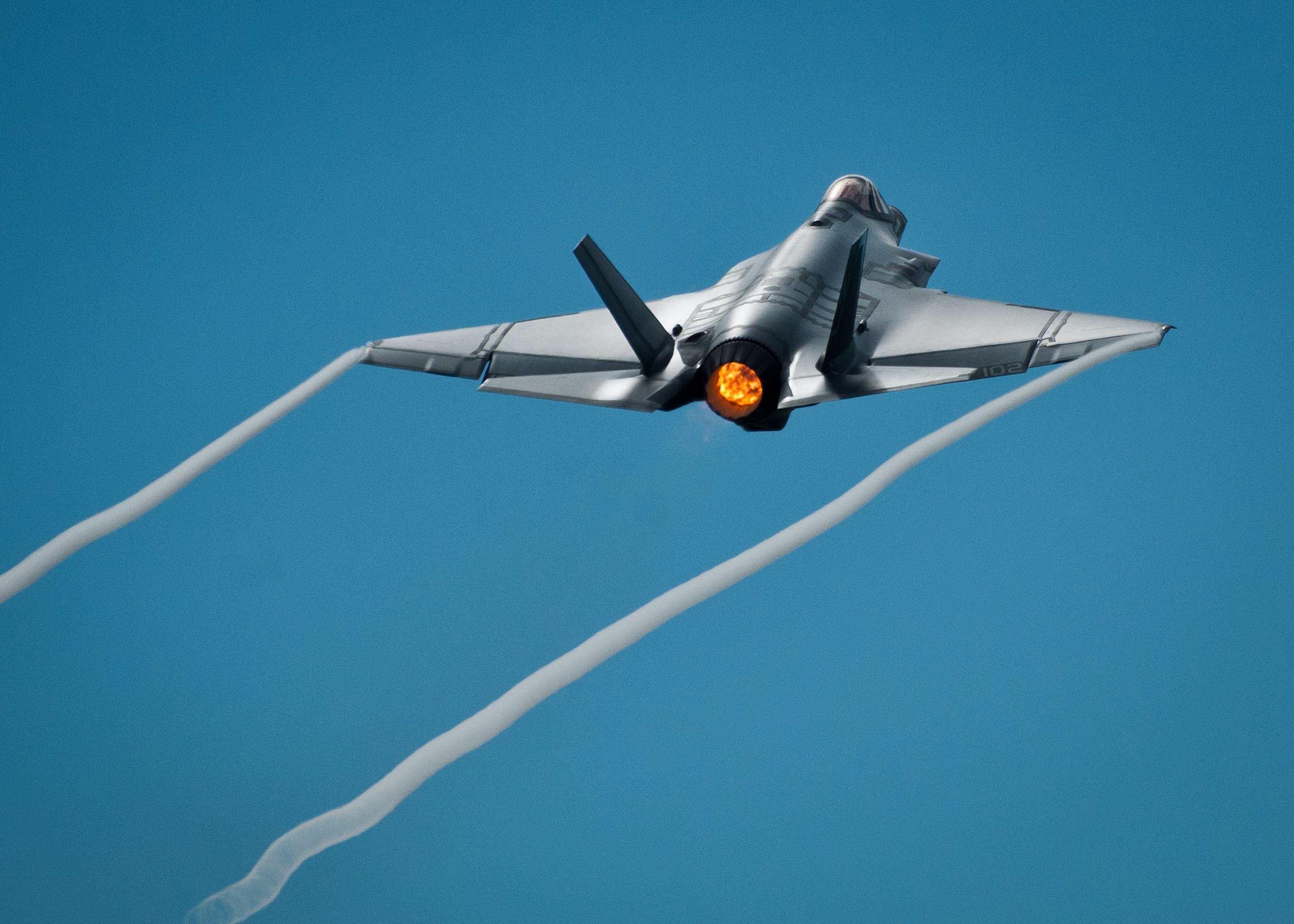
An F-35C Lightning II aircraft on Aug. 14, 2013 at Eglin Air Force Base, Fla. US Navy Photo

The U.S. Navy will need to use a combination of stealth and electronic warfare capabilities to defeat advanced anti-access/area denial (A2/AD) threats in the future, chief of naval operations Adm. Jonathan Greenert said on April 16 at the U.S. Naval Institute annual meeting in Washington, D.C.

“[Stealth] is needed for what we have in the future for at least ten years out there and there is nothing magic about that decade,” Greenert said. “But I think we need to look beyond that. So to me, I think it’s a combination of having aircraft that have stealth but also aircraft that can suppress other forms of radio frequency electromagnetic emissions so that we can get in.”

Electronic attack by itself will probably not be enough to enable U.S. forces to penetrate enemy air defenses, according to Greenert and multiple U.S. military and industry sources.

“I doubt in the future we can just suppress everything, go rolling in until we do what we need to do and get out,” Greenert said. “But we have the means for—way out in the future—with the Next Generation Jammer and what it’ll bring, to be able to get in when we need to and get out.”

Greenert’s comments largely mirrors a Boeing presentation last week at the Navy League’s Sea, Air and Space exposition where Mike Gibbons, the company’s vice president for the F/A-18E/F and EA-18G programs, had stated that stealth aircraft must be supported by airborne electronic attack capabilities.

“The point is anybody that goes in can’t be good against any one frequency band because you will be seen by others, that’s the key,” Gibbons said. “The Growler is the only aircraft that has that full spectrum sensor and jamming capability to take care of that for strikers.”

The Boeing presentation also reiterated the company’s oft-stated position that low observable technologies are a “perishable” asset—particularly as potential enemies develop advanced low frequency radars and signal processors become ever more capable.
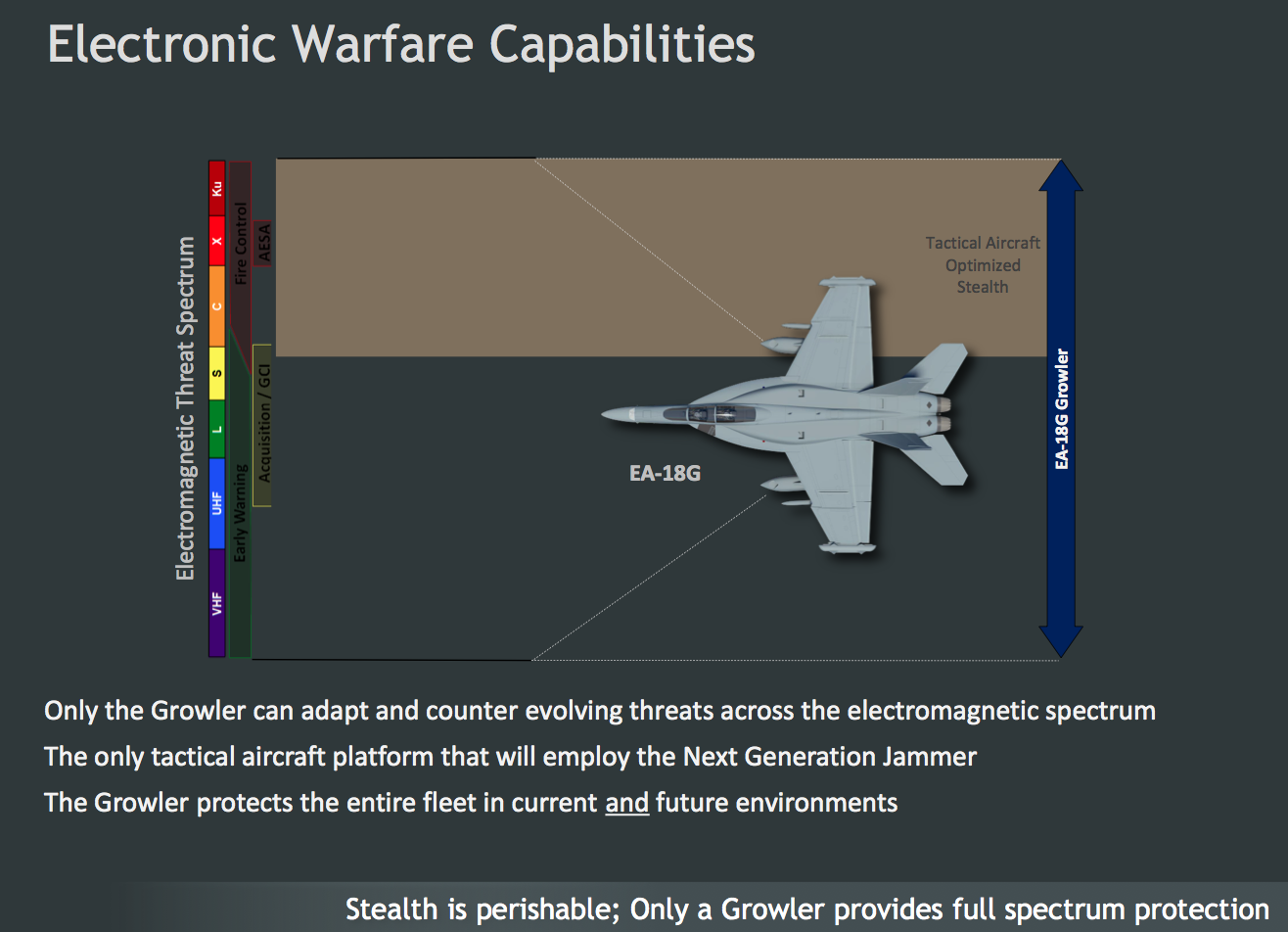
Boeing Presentation

“Stealth is ‘delayed detection’ and that delay is getting shorter. SAM (Surface-to-Air Missile) radars are shifting their frequencies into lower frequency bands where U.S. stealth is less effective,” said Mark Gammon, Boeing’s F/A-18E/F and EA-18G program manager for advanced capabilities, in an emailed statement. “Early warning radars are in the VHF spectrum where stealth has limited if any capability. These radars are networked into the SAM radars giving the SAM radars cued search. The threat is developing out of spectrum sensors like IRST [infrared search and track] systems on their fighters. Stealth has no capability to delay an IRST detection and track.”

While some military officials consulted by USNI News wholeheartedly concurred with Boeing’s assessment, others dismissed the company’s claims out of hand. Many others offered a more nuanced view.

“Boeing is in full-court press against the [Lockheed Martin] F-35 in this briefing. As such, when they describe the advantages of the Growler–which are accurate–they ignore the tradeoff for that advantage,” said one U.S. Air Force official. “The truth is that the Growler and LO [low observable] platforms complement each other extremely well.”

Lockheed Martin officials, however, maintain that the F-35 is able to operate inside highly contested airspace without any support assets.

“By government contract specification, the airplane is required to be able to go into high threat anti-access environments, autonomously perform its mission and survive,” said Eric Van Camp, Lockheed’s domestic F-35 business development director. “The results of flight test indicate conclusively that the airplane will meet that contract specification.”
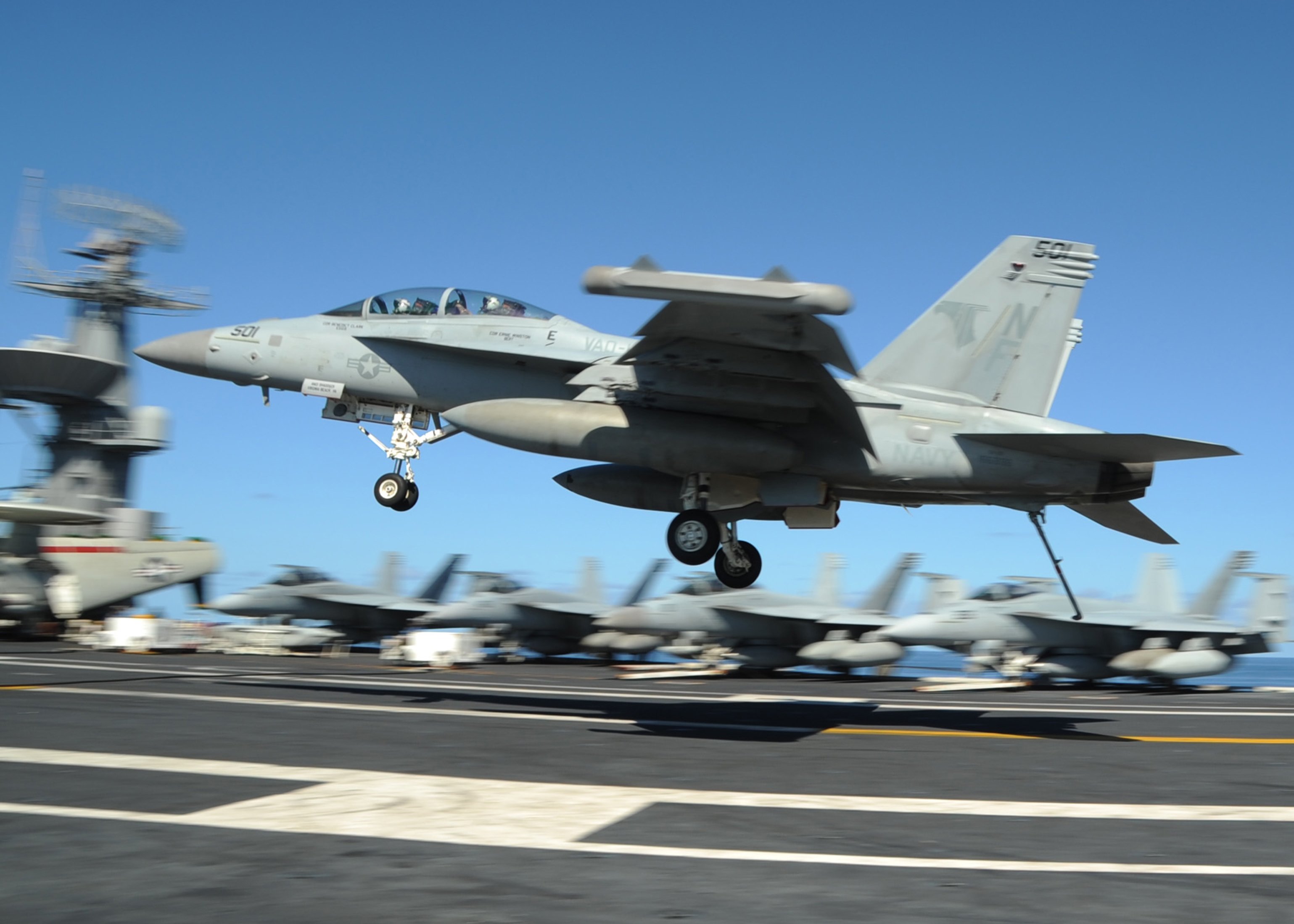
An EA-18G Growler from the "Shadowhawks" of Electronic Attack Squadron (VAQ) 141 prepares to make an arrested landing on the flight deck of the U.S. Navy's forward-deployed aircraft carrier USS George Washington (CVN-73) in 2013 US Navy Photo

While it is an indisputable fact that a tactical fighter-sized stealth aircraft must be optimized to defeat higher-frequency bands such the C, X and Ku bands as a simple matter of physics, in a real world operational setting, there are often other factors involved that make detecting and tracking a stealth aircraft more difficult.

Industry, Air Force and Navy officials agreed that there is a “step change” in an LO aircraft’s signature once the frequency wavelength exceeds a certain threshold and causes a resonant effect.

Typically, that resonance occurs when a feature on an aircraft—such as a tail-fin — is less than eight times the size of a particular frequency wavelength.

Effectively, small stealth aircraft that do not have the size or weight allowances for two feet or more of radar absorbent material coatings on every surface are forced to make trades as to which frequency bands they are optimized for.

“You can’t be everywhere at once on a fighter-sized aircraft,” said another Air Force source.

What that means is that a radar operating at a lower frequency band such as parts of the S or L band—like civilian air traffic control (ATC) radars — might be able to detect and possibly even track certain stealth aircraft to an extent.

However, a larger stealth aircraft like the Northrop Grumman B-2 Spirit, which lacks many of the features that cause a resonance effect, is much more effective against low-frequency radars than, for example, an F-35.

But those lower-frequency radars do not provide what Pentagon officials call a “weapons quality” track needed to guide a missile onto a target.

“Even if you can see an LO strike aircraft with ATC radar, you can’t kill it without a fire control system,” an Air Force official said.

Meanwhile, Russia, China and others are developing advanced UHF and VHF band early warning radars that use even longer wavelengths in an effort to cue their other sensors and give their fighters some idea of where an adversary stealth aircraft might be coming from.

But the problem with VHF and UHF band radars, as one U.S. Navy official told USNI News, is that with long wavelengths come large radar resolution cells.

That means that contacts are not tracked with the required level of fidelity to guide a weapon onto a target.

“Does the mission require a cloaking device or is it Ok if the threat sees it but can’t do anything about it?” the Navy official asked rhetorically.

Further, officials from the Air Force, Navy and Marine Corps agreed that while aircraft like the F-35 or F-22 are not solely relying on low observables for survivability—stealth is an absolute requirement to survive in an A2/AD environment even with airborne electronic attack support.

As one Air Force official explained, stealth and electronic attack always have a synergistic relationship because detection is about the signal to noise ratio. Low observables reduce the signal, while electronic attack increases the noise. “Any big picture plan, looking forward, to deal with emerging A2/AD threats will address both sides of that equation,” he said.

Air Force and Marine Corps officials took exception to Boeing pointing out that the F-35 only has X-band electronic attack coverage from the front. “Aft coverage may or may not be provided onboard any given fighter, but is provided by the package overall — which will likely include EA-18s,” one Air Force official pointed out.

However, Air Force and Marine Corps officials said that the Growler may not be particularly useful against emerging threats and noted that there are electronic warfare upgrades planned for the F-35 in addition to its baseline capability.

“The Growler itself, while a very credible aircraft, has limited suitability in an advanced A2/AD area,” one Air Force official said.
“While it is the state of the art for now, I don’t know if it will be the appropriate jamming platform for the pictured environment.”

Nonetheless, a number of Air Force officials expressed support for the Pentagon potentially increasing the size of its Growler buy. “The Growler is a great asset, we probably need more, and it is an important part of a strike package into an advanced IADS [integrated air defense system],” one official said. “It is not as stand-alone as Boeing will claim.”

However, those same officials pointed out that the Growler is not fully interoperable with joint forces.

“If there is a major enduring shortfall to the Growler, it’s the degree and fidelity between it and other joint suppression platforms. The reasons for which could be as benign as joint interoperability [being seen] as an afterthought,” one Air Force official said.

But “it’s to Boeing’s advantage to propagate a limited interoperability platform, especially one that doesn’t communicate very well with competitor’s platforms in the SEAD/DEAD [suppression of enemy air defenses/destruction of enemy air defenses] mission. But it doesn’t make sense from a warfighter position.”

An industry source agreed that the Growler still faces interoperability problems when operating with Air Force assets, but that is true of many platform across the board. “There are interoperability issues across a lot of the platforms,” the industry source said. For example, Lockheed F-22s are only able to connect with other Raptors using the Intra-Flight Data-Link (IFDL), while the F-35 uses a Joint Strike Fighter-only Multifunction Advanced Data-Link (MADL). “This is one of the bigger issues the Air Sea Battle Office is attempting to resolve,” the industry source said.

Gammon defended the EA-18G’s ability to operate with other Pentagon assets. “Growlers have Link 16 which is compatible with [the] F/A-18 Super Hornet and F-35, E-2D, F-15, F-16, and most of the bombers,” he said. “The good news is the Growlers can stand-off from the threat, build the EM [electromagnetic] picture, and pass weapons quality tracks to the other fighters via Link-16 (and soon TTNT [Tactical Targeting Network Technology]).”

The industry source noted that while the F-35 will be fitted with the Link-16 datalink, it would not be able to use that omni-directional link inside a high threat environment because it could compromise the aircraft’s position. “Aircraft such as the F-35 that might not want to transmit on their Link-16 can always receive Link-16 tracks from Growlers and employ weapons on those tracks,” the industry source said.

Air Force officials conceded that the Pentagon probably needs more EA-18Gs.
“In truth, we never bought enough Growlers in the first place,” one Air Force official said.
“They’re worth their weight in gold, and contribute immensely to the ES [electromagnetic spectrum] situational awareness and EA [electronic attack] communities. But the LIMFAC [limiting factor] is, and always will be, the carrier deck park and cycle times.”
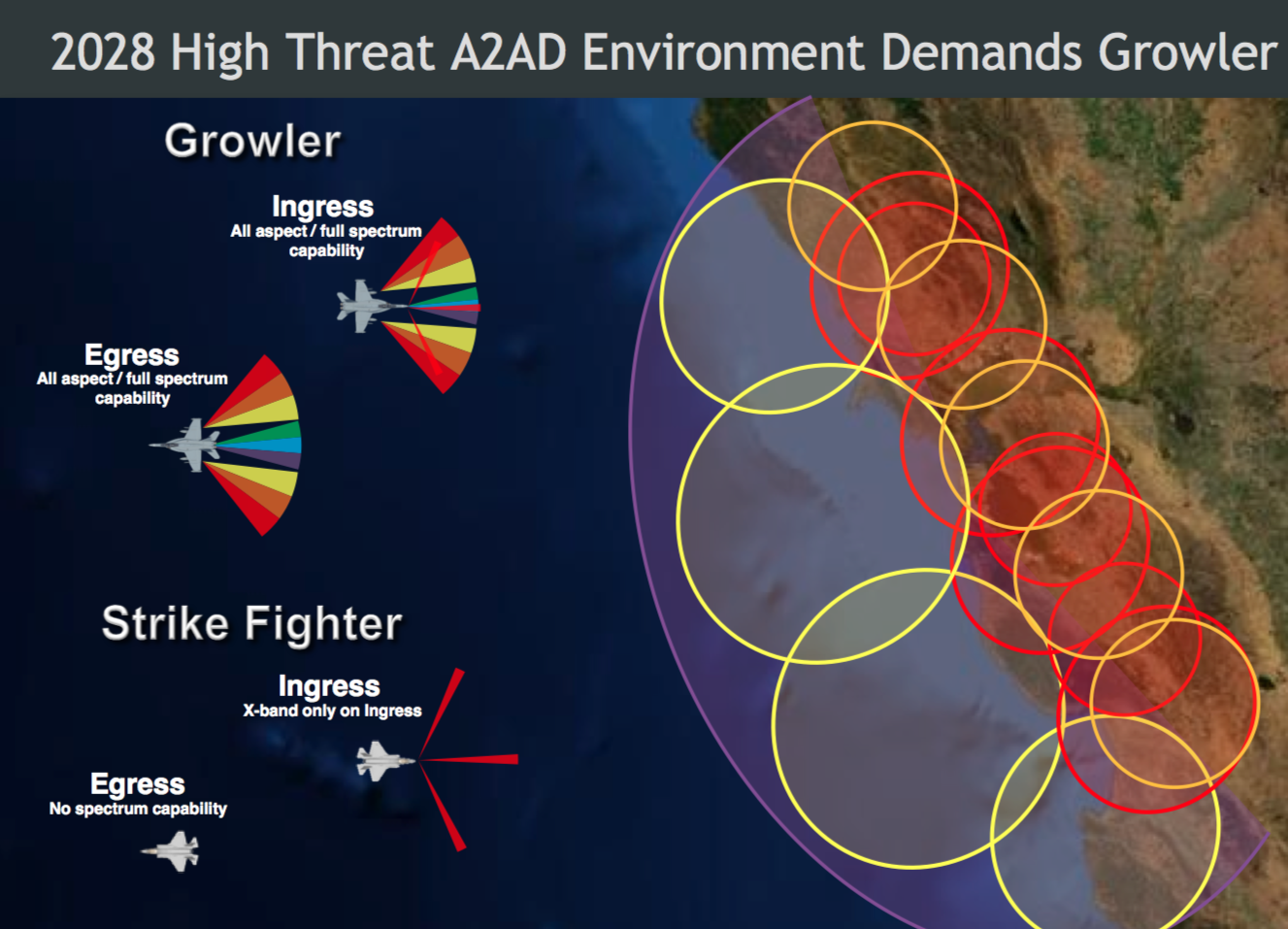
Boeing Presentation.

A Navy official said that the carrier deck cycle would be a limiting factor only if the Growler was being used to launch missiles such as the AGM-88E Advanced Anti-Radiation Guided Missile (AARGM) or the High-speed Anti-Radiation Missile (HARM). The official noted that with aerial refueling it is not unheard of for Navy fighters to remain airborne for more than six hours at a time. “If the Growler was kinetic, launching all its HARM and then needing to reload… Yes, the deck cycle time would come into play here,” the official said. “But, it’s more realistic to provide standoff jamming than launch HARMs unless in a self-protect role.” The official also pointed out that the need to land, refuel, swap crews, and perform maintenance at some regulated interval is a requirement for any aircraft.

Boeing also suggested in its presentation that the Growler could be used in the counter-air and strike roles. Gammon elaborated on how Boeing envisions the EA-18G might perform some of those missions—distancing the company’s position somewhat from the diagrams shown in the presentation. “In the counter-air mission, the Growlers will use their ESM [electronic support measures] system to help the fighters detect, and just as important, ID the threat. They can do this from a stand-off position from the fighters and still contribute to the overall SA [situational awareness] and ID,” Gammon said.

Gammon also clarified the company’s position with regard to using the EA-18G in the air-to-ground strike role. “In the strike mission, the Growler is supporting by building that enemy EM order of battle, find, fix, track, and ID those threat emitters and then quarterback the EM fight and determine which of those threat systems we are going to jam, attack, avoid. The Growler can employ weapons such as the AARGM at those emitters as well as handing off that track to a strike fighter to engage.”

Navy officials had said that while the service might consider using the Growler as a battle manager, it is extremely unlikely the service would ever consider using the EA-18G in a direct strike role or the air superiority role where the jet would be the primary shooter.

An industry source conceded that while the Growler would likely never be used as an air superiority fighter or strike aircraft, it could play an important role in those missions. “I do agree that Growlers will not be bringing JDAMs [Joint Direct Attack Munition] to a target,” the source said. “They will support the strike fighters as they fight their way into the target area.”

Though there is broad support for purchasing additional Growlers, it is not a stand-alone solution for dealing with advanced A2/AD threats.

“Stealth has its flaws, as the brief points out; however, if a new pod on a fourth gen platform was a workable answer against the modern and future IADS, I’m about 100 percent certain that USAF [U.S. Air Force] would be trying to buy a pile of them as well,” an Air Force official said.
“But the juice ain’t worth the squeeze, as they say.”

Posted in HX-ohjelma, ilmavoimat, SEAD, teknologia, Tilanne päällä | Tagged , , | Leave a comment

HX-FRP, What do the documents say?

First the disclaimer: I’m just interested party, ultimate payer and a blogger, in HX-Fighter Replacement Program. I have never seen and much likely never will see the wheelbarrow loads of documentation that the HX-FRP produces. But I try to make an educated guess what is meant by the hints the Finnish Air Force gives out.

EndI’m referring to you the pages 35 to about 44 of the preliminary study of HX program which is of course in Finnish but I sort of comment and in English so you should be able to have a pretty good clue what that preliminary studies is talking about. SO if you have time and inclination in your hands feel free to use Google translate or some other translation program. If you are “Finnish Impaired” BUT here is the link for Esiselvitys

up 87 preliminary study for the HX fighter replacement program first this late stage the capability to function in offensive and defensive air combat.  this means that the capabilities in this disciplines all the most important capabilities to be hard in the HX program.  Kinematic performance, meaning maneuverability, speed and service altitude, are considered to be most important in this category.  As I have pointed out the air-to-air missiles and all the other weaponry will be largely the same for all of the contenders. So small edges can really only be extracted fro planes own physical characteristics.  The central role of the future fighter has to perform in operations against strategic strikes and hybrid warfare. Of course it is the Air Force but it’s mostly responsible over protecting the army and the central functions of society and political decision-making in hybrid- and regular Warfare. 

This is because air defense constructed only with air to air defense missiles will leave large bubbles where enemy Air Force can do whatever hell they please.  Also the upper limit of ground based air defense missiles in Finnish use is around 10 kilometres which will leave another 5 kilometers for enemy Air Force to use. So this just AA missile of air defense is non starter for Finland. So while AA missiles are OK defensing important point targets and large dispersed targets, they will not be able to cope defensing the whole infrastructure and important facilities. 

Especially the defensive counter air places high demands for speed and service altitude for the HX-fighter plane.  So it would seem that in this category Eurofighter Typhoon should be very strong,  closely followed by Saab Gripen.  Defensive counter air also depends largely on networking of defensive assets and on the sensor suite of the fighters themselves. Components for these come globally from just a couple of places, so difference will largely lie on physical characteristics of lenses in IRST and radar dishes in radar domain. All contenders will have these, IRST and AESA-radar, and I suspect the differences will be quite small in performance. Most difference in performance likely coming from the width of radar’s dish.

Also the ability to use latest helmet this place is mentioned here  Aspen create air-to-air combat  asset.  this is of course true considering what kind of a shock East Germanys MiG-29 with their helmet guided missiles with  West Germany’s and all the rest NATO pilots, in early 1990’ies. MiGs were able to fire missiles off bore axis, which western planes were not at that time. Also the Deep strike as a part of offensive air-to-air missions is mentioned in the preliminary study  as a way of hampering enemy’s capabilities of using there radar command and sensor networks and also communications and propaganda networks as a part of a offensive campaigns against Finland. 

Second category mentioned is “affecting” this in Finnish Air Force parlance is made up of “kinetic affecting” with bombs, missiles, guns and what’s not and “non kinetic affecting” with the jammers or other electronic means.  This is important because with the fighters with quite limited amount of platforms it  is quite easy to build nationwide capability for these kinds of missions.  From the Great Northern wastes of Lapland to the beautiful islands of southern Ålands.  So HX-FRP fighter needs to have a quite a good carrying capability and wide range of different means of affecting enemy.  I do not know how it is in other nations what in Finnish Defense Forces “affecting continuum”  is divided into a few layers beginning in from humble infantryman’s assault rifle,  to the company’s mortar platoon and on wards to their battalion’s Mortar Company and on wards to brigades field artillery regiment. From Brigade level the affecting steps up to the Army group where there is Rocket launcher batteries and 155mm “operative artillery” and MLRS and then lastly in the high commands Air Force and their means of affecting. Thinking is that range and types of targets affected grows in importance. The range of affecting growing from from infantryman’s few hundreds of meters to Air Force’s hundreds of kilometers.  There are no “Missile troops” as such in Finland at least yet.  From said in here about the platform for the Air Force there needs to be a good carrying capability or good range standoff and,  other kinds of missiles. (Anti ship missiles of course spring readily into mind). Also here is a good selling point of F/A- 18 G Growler Fighters with their wide and varied undo radar and on the communications capabilities. Boeing said they’ll sell what is wanted, but I’m not sure has these been asked. And of course President and Congress need to be in the same mind as well.

In my humble opinion, even though I have no doubt that the French in the Dassault Rafale and the Swedes with SAAB Gripen have done Sterling job in their respective fighter’s self protection and electronic warfare capabilities one jammer just doesn’t cut it when you’re trying to make an electronic attack airplane. And as I have pointed out previously we are not operating in Mali or Libya where Air defense network is not present or rather depricated, but in the presence of the world’s most formidable air to air defense missile Network so all the capital it is in this area need to be top-notch & Beyond.

The Deep strikethrough ability is mentioned here which should be the domain of the Lockheed Martin’s Joint Strike Fighter and the Dassault Rafale.  F-35 Joint Strike Fighter because of its abilities against enemy radar and Rafale because of her outstanding carrying capacity and deep strike optimization for the French Air Force.  Rafale is supposed to be able to deliver France’s nuclear missiles deep into enemy territory, so of course, the capabilities in deep strike have to be really really good. Of course the goal is not to sacrifice an airplane if you can just get around with using an stand off missile but sometimes you have to go deep in order to be able to launch that missile. 

In the same chapter it is also mention that the targets will move and appear and disappear very rapidly so the speed of action he’s also quite important in the selection all the fighter this translates into the car in Capitol 80 so that you can have a wide variety of different effect missiles on the plane when you take off this seems to play into the pockets of Boeing F/A-18 E and Dassault Rafale. But as all still carry a respectable amount of ordnance, and what is more somewhere is less in somewhere else.

Third category mentioned is a  reconnaisance, guarding, or policing, and targeting capability. As mentioned before the capability to function against a strategic strike or Hybrid warfare it seem to be very important for the future fighters and also their air policing flights will take them far over the Baltic sea, where they have to police de-militarized zone of Åland islands. Ålanders, Finns Swedes and rest of Europeans alike feel that Ålands are demilitarizied, but Soviet Union NEVER said such a thing, and this goes as well for the new Russia. From Finnish point of view, Ålands cannot be allowed to fall into enemy hands. Same goes fro Swedes and NATO, as defense of Baltic 3 will be quite hard if Ålands function as an unsinkable flattop and her battle group in northern Baltic.

The ability to produce recognizance information and policing will be most important in the Southern Coastline of England as well not to mention not to mention the northern part of area which is largely sparsely populated.  also the survivability of the fighters is mentioned here and a little there defensive electronic warfare capabilities.

Last link that follows the other missions.  Starting from SEAD and DEAD missions against enemy air defenses And radar Networks in order to facilitate all the cons of Air Force missions.  so air force fields that some kind of electronic warfare and suppression of enemy air defenses capability will be needed in the future Fighters butt it goes maybe the time over in facing its value but I feel that at least 1/5 of the planes acquired in HX Fighter replacement program need to be SEAD capable.

I don’t know why the swedes think that they can manage without dedicated wild weasel or Growler how ever automated the systems are. But I feel that Finland should get a quite a few Growlers so if you can get two seaters and maybe modify them to carry electronic warfare pods of different kinds as well as the anti-radiation missiles in order to be able to wage DEAD warfare against S-300 S-400 and S-500 missile complexes.  After all you cannot fly very high from at least the eastern part of Finland before you will be in some of the system’s radar.

Further I would like to point out, that HX-FRP’s need to be able to take off from highway bases, and be maintained in quite austere enviroment. So plane needs to be rugged enought and not to require 2000m runways to be able to take off and land. I’m not sure WHAT distances have been asked, but I guess 600 m of pavement should be enough for war birds of Finland. Thought is that a plane never lands on same base it took off from, so that assessing Air force placements and buildups are harder to detect.

Posted in HX-ohjelma, ilmavoimat | Tagged , , , , , , | Leave a comment

ISIS Strikes back, Time for the EU Commission to wake up and smell the coffee.

New info has surfaced in from of documents obtained from Syria about the ISIS plans of terror attacks in Europe. Still the European Commission wishes to disarm Europeans and all European Law Abiding gun owners in order to facilitate more terrorist strikes in Europe.

European Commission believes that somehow the disarmament of Law abiding citizens will somehow make terrorist attacks in Europe impossible. This is, as Everybody can understand, delusional. Terrorists are not buying semi automatic weapons from your local friendly gun stores to make full auto weapons for terrorist attacks. They are getting their  military surplus from Balkans and maybe even from Middle East to commit these heinous acts. These are lies by EU commission debunked by Firearms united time and again.

EU Commission has decided that “fighting terrorism” is good Straw man to beat while  advancing their deplorable socialist agenda on Europeans. In fact, Interpol’s chief said already in 2013 that Only way to hinder terrorist attacks in Europe is to bring about some kind of concealed carry licensing for the Law Abiding Citizens. So regardless what Juncker says,  we, Europeans, need more guns in the streets in the hands of Law Abiding Citizen’s not less.

Of course we do not know the particulars about the ISIL/ISIS papers, but I see That For example Finland, for 80 foreign Fighters have gone into Syria and SUPO knows about 20 that have returned. People followed for terrorist connections has ballooned 50% from 2015. So we higher probability of terrorist attacks in Finland. This threath level creeping up is not lessened by the fact that Finland is helping Kurdish Pesmerga to fight ISIS.

So In order to alleviate the pressure in their home turf ISIS will start making more spectacular terrorist strikes all over Europe most of all in Northern Europe, Finland Sweden, Norway and Denmark because These are relatively soft targets without Prior Experience in Handling of terrorists. The Germans, the French and Italians  for ex sample have troves of experience to draw on from the times with the Communist terrorist organizations in 1970’ies.

 Yeomenry, or reserve service, is nothing new for the Nordic countries, The serfdom apart from Denmark was virtually unheard off in much on the Skandinavia. Also in the Nordic states have had or haw compulsory national service for all able men(and women as time now stands. Yes, Even Sweden is coming back.) This means every Nordic country have hundreds of thousands of reservists that can be put into gear, if need be for internal or external threats. Granted some have not touched arms since last refresment, but some, like me, spend countless hours in honing their skills in range. Not everybody is needed for field army, so maybe internal ministeries and police should start training their own sticks for COIN warfare in the urban enviroment. Situation in Malmo and Gothenburg IS by now a internal unrest, maybe a 1 cent short of COIN war. 

ISIS has infiltrated into Europe thousands of terrorists, Eu think-tanks estimate about 1-2% of terrorist in total refugee flow. Out of about  three million that means 3000-6000 terrorists. For Finland that means 300-600 Terrorist out of 30 000 refugees. Paris terror attacks were accomplished by about 10 Terrs on total. Sounds scary? It should.

So even here the key for making country less appealing target for terrorism revolves around getting MORE good trained gunfighters into streets, and not less. Where is improve Security services Now we just have to have the political will to introduce legistlation for concealed carrying for our citizenry and maybe starts.

It seems that Palace eunucs of Bryssels are more than happy to see European blood spilled on the streets rather than have security for everybody. Or is it that Euro-Tzars fear for their own subjects? I think the heart of the matter is  not the terrorism but mounting disapproval of normal law abiding Europeans the Brussels is so fear full about.  Drug gangs, 1% Motorcycle clubs and Terrorists do not need EU commissions approval to guns they want, It is just the regular guys who need or or even want it.

Threath of terrorism is not going to go away, Idle hands and minds will turn into smaller and bigger mischief.  But on the short term, Concealed carry, on the longer term integration into society is the best cause to take. But make no mistake: If you want peace in Europe from terrorism. You have to respond swiftly and brutally to every slight of National territorial integrity or authority in own soil.

So, How about banning the #eugunban?

Posted in Aseet, Aselait, sisäinen turvallisuus, terrorismi | Tagged , , , | Leave a comment

HX-program, Whew are we now?

Now it is at least “semi offical”: Minister of Defence, Jussi Niinistö (PS) said “it is possible to get fighters from two different countries” Link HERE in Finnish.

This would mean a Air Superioirty fighter, Gripen or Typhoon, combined with Strikefighter, F/A-18E Advanced or Rafale.

This kind of approach may cost more money, but bring about better FAF. Maybe more of this to come..

Posted in HX-ohjelma, ilmavoimat | Tagged , | Leave a comment

Häivetekniikka ja aktiivinen kumoaminen; HX koneet häivesyynissä

Suuressa maailmassa tutkitaan mahdollisuuksia kumota toisen tutkan signaalin energiaa lähettämällä vastakkaisessa aallossa olevaa signaalia takaisin omalla tutkalla. Esimerkiksi tämmöinen artikkeli löytyi pienellä guugletuksella. Active radar cancellation– juttu.

Periaate on hyvin sama kuin vaikkapa matkustaja lentokoneissa, joissa lentomoottorien turbiinien melu onnistutaan poistamaan vastakkaisella melulla. Siis vastaäänilaitteella. Laite vain kuuntelee moottoiren kierroksia ja siten sieltä tulevaa äänen Hz taajuutta, ja säätelee omaa lähetettävää siniaaltoaan samalle taajuudelle, ja etsii lähetyshetken, jolloin ääni ja vastamelu ovat vastakkaisissa vaiheissa. Tällöin ääniaallot sitten kumoavat toisensa.

Samaa tehdään siis myös tutkilla, Temppu on kertaluokkaa vaikeampi, koskapa ääni ilmassa etenee sen vaatimattoman 340m/s ja koneen rakenteissakin melko säälittävän 5000m/s, Prosessori, jonka taajuus on vaikkapa 5MHz  eli  viiden miljoonan Hertzin huitteilla, ehtii tehdä sen yhden laskutoimituksen samassa ajassa kun ääni etenee 5000000mm/s / 5000000Hz, eli noin millin. Ihmiselle kuuluvat taajuudet ovat 20000 Hz alapuolella, joten yhden laskutoimituksen aikana (laskennallisesti, oikeasti ilmassa ääniaallot ovat pitkittäisiä aaltoja, kuten 7lk ääniopin kurssilta kaikki muistavat.) Sitten aaltomuotona jonkinmoinen sini-aalto. Eli aalto menee ympyrän 360 astetta tai näin kun matematiikasta/fysiikasta puhutaan, niin 2π aina aallonpituudessa. (Eli, jos nyt vaikka aallonpituus olisi juuri 360 cm, niin muutosta tapahtuisi aste sentillä) Tuon Linkkaamani artikkelin mukaan virhe tuossa aallon vaiheessa ei saa ylittää 60 astetta, koska silloin kaikki menee ihan häneksi, ja vasta-aalto alkaakin vahvistaa tai ainakaan ei heikennä varsinaista aaltoa.

Eli periaate on ihan selkeä: Pitää löytää sopiva taajuus, sopiva aalto ja lähettää juuri vastakkaishessa vaiheessa varsinaiseen tutkaan nähden. Vaikeus tulee siitä, että nyt tässä systeemisää KAIKKI etenee valon nopeudella. Meillä on tietenkin tietokoneet jotka ovat jo GHz luokkaa, Joten varsinainenlaskutoimitus menee 300 000 000 m/s / 3 000 000 000 Hz= 0,1 m/s eli valo etenee “vain noin” 10cm aikana kun tietokonen tekee yhden laskutoimituksen. (Tietenkin huomioonottaen sen onko kone 1 GHz vai 6 GHz, matka on pidempi tai lyhyempi, aina ylläolevan jakolaskun mukaan.) Näillä tietokoneen  nopeuksilla on sitten jo mahdollista tehdä sama miinuslaskutemppu jo valon noputta etenevälle, ja aallonpituudeltaan alle millimetrin pituiselle aallolle. Tietenkin vaikeutta tempussa lisää se, että signaali kulkee kuparissa samoja nopeuksia kuin tutka-aalto ilmassa, joten oman järjestelmän hitaus täytyy tuntea hyvin, että vasta-aalto saadaan lähtemään oikeaan aikaan, että siitä on hyötyä. ;yös oma paikka, ja mittaavan tutkan paikka on paras tuntea hyvin, että mitää vaihevirhettä ei pääse tapahtumaan.

Eli suoritus on käytännössä vaikea, mutta periaatteessa helppo, ja reaalimaailmassa saataneen onnistumaan kohtuullisella varmuudella, koskapa Ranskassa ja Ruotsissa on lähdetty tämän tekniikan varaan Rafalen ja Gripenin omasuojan kohdalla laskemaan. Toki näissä koneissa, sekä tietenkin Typhoonissa, on kaikkia järkeviä rakenteellisiä ratkaisuja joilla koneen tutkapoikkipinta-alaa voidaan laskea on käytetty samoinkuin sopivia pintamateriaaliratkaisuja, mutta muotoilua ei vain ole viety niin pitkälle kun se F-35 koneen kohdalla on tehty.

Tosin tässä vaihtokaupassa USAF on saanut koneen, joka on vaikea havaita tutkassa melkein koko pallon alueella, ilman monimutkaisia lähetin/laskenta ratkaisuja. Se sitten kumpi on “parempi” ratkaisu aerodynaamisesti loistava Eurocanardi, joka käyttää tutkaansa hämäämiseen vai tutkassa lähes näkymätön, mutta aerodynaamisesti heikompi kone. Sen tulee tulevaisuus, eli se seuraava sota, näyttämään.

Posted in elektroniikka, HX-ohjelma, teknologia | Tagged , , , , , , , , , , | Leave a comment

This year’s winter Artillery camp is over.

Finnish Artillery troops has had last camp of 2016. These camps are called “maavoimien vaikuttamisharjoitus” Or “Land components affecting practice” But in short Artillery fires starting from 82mm mortars all the way to 227mm rockets will be fired, and great fun will be had by all. Camp takes place in Rovajärvi training area.

What has been really nice this year is that due the change of stewardship of Finnish Navy guns, (from Navy, who is responsible for coastal artillery, to Army who is responsible for field artillery) it seemed like Finland had miraculously gotten about 1000 pieces from 2014-15. Needles to say greenie-lefties had a shit paralysis because of it. Finnish broadcasting corporation had it in daily politics show and whatnot. Me and rest of Artillery guys had a good time!

The videos have english text. so you can have them displayed.

Unfortunately because I’m a bad person, I cannot display the videos, but here you go FDF Youtube 

Especially this video was nice. Courtesy of Lapin Kansa

Today 25.11.2016 out came the last video.

Posted in armeija | Tagged , , | Leave a comment

HX program took a step forward

First a disclaimer: I’m not serving in Air Force, nor did I recieve the orginal RFIs from anywhere. I have tried contacting the manufacturers, but I have not always been succesfull of getting more information on HX fighters. 

All RFIs came in yesterday 22.11.2016 for materiel command of Finnish Air Force. There are thousands of English language pages in each RFI so next step forward won’t be until 2018. YLE finnish broadcasting corporation seemed to be overly concerned about lobbying the evaluation personnel.(and journos as well) but fails to see that in yhe end the decision is political one.

The differences between fighters here are quite small. Eventually the armaments will be the same, and to great extend the sensors, or components of sensors, come from same companies. so even there the differences should be small. Though the days of piston engine fighters are long gone, there is still, smaller but still there, differences in kinematic and physical performance. Also it used to be that Western planes enjoyed edge in avionic systems, even the differences between Russian and Western avionics suites are quite small, let alone between western fighters themselves.

So the greatest differences between planes are in political and economical spheres. Even there SAAb, Dassault and BAE are in equal terms as all are EU allies, and all have offered an assembly line for Patria, and are offering R&D partnership for the future. US makes a bit of difference here. Repairing and Assembly of the F-35 will happen in Italy, which is too far away from Finland to be viable option for wartime FAF. Boeing did not have problem assembling some of the F/A-18 C s in Finland, so most likely there would not be problem this regard with E either.

So where will the devil lie in HX-replacement program? It will lie in doctrine of FAF: The planes need to be able to take off and land to short runways, be managed by small teams of mechanics, be able to be quickly dispersed, and be rugged enough to take wear and tear of wartime use. SAAB Boeing and Dassault feel that they can fill the bill. Lockheed Martin and BAE are a bit of a question mark in this regard. At least F-35 ability to operate from dispersed airfields leave a lot of questions. USAF plans to use hardened bases, not dispersed ones. USMC version might do better, but I do not know what is being offered.

Also pricing was asked for 18-36-72 planes, so it would seem, that the about 72 planes is the option Finns are thinking. (It is still a bit low, but nobody is asking me.)  and the offer CAN incorporate unmanned platforms as part of the deal.

I’m sure there is more to tell in close future.

Posted in HX-ohjelma | Tagged , , , , , , | Leave a comment

Sisäinen turvallisuus, ISIS ja SUPO

Eli SuPo sitten tiedotti(Kaleva, YLE, Iltalehti, HS) tänään tämmöistä: Suomesta ISISkseen lähtenyt noin 80 henkilöä. suomalaislähtöisiä edennyt ISIksen johtotehtäviin.(Veikkaan että pikemminkin keskijohtoon, kuin sinne pyramidin terävämpään päähän.) ja että Suomeen on palannut noin 20 taistelijaa, jotka ovat, yllätys yllätys, hyvin turvallisuustietoisia. Seurattavien määrä on noussut vuodessa 50%, aika huomattava kasvu siis. SuPo on toimittanut myös KRPlle “useita” kokonaisuuksia tutkittavaksi.

Suomi on osallistunut muiden länsimaiden kanssa ISIKsen vastaiseen rintamaan, ja kouluttanut Peshmergoja Irakin ja Syyrian raja-alueilla. Aivan oikein. Nyt kuitenkin tilanne lienee se, että lähtölaskenta Suomen ensimäiseen omaan terroriiskuun on alkanut. Suomi on oleellisesti pehmeämpi kohde kuin Ranska ja pariisi. Ransakn turvallisuusviranomaiset ovat kuulemma “estäneet useita” terrori-iskuja Ranskan alueella.

Suomella olisi vielä aikaa tehdä ainakin yksi juttu, jolla Charlie Hedbon ja 13.11.15 pariisin iskujen tapaisten terroritekojen vaikutusta voidaan lievittää, ja yleistä turvallisuutta parantaa. Nyt ehtii vielä laittaa täytäntöön Interpolin suosituksen tavallisten kansalaisten aseenkannon legalisoimisesta. Siis käytännössä USAn joidenkin osavaltioden Concealed carry tyyppinen ratkaisu. Tyypillisesti tavalliset kansalaiset ovat ensimäisiä terrori-iskun tapahtumapaikalla, ja voisivat sitten omilla aseillaan taisitella vastaan, sensijaan että joutuvat jäämään odottamaan omaa vuoroaan teloituksessa. Tästä on hyvät kokemukset esimerkiksi 2013 Westgate terrori-iskussa, jossa paikalliset pystyivät auttamaan uhreja paljon ennen kuin varsinaiset viranomaiset saivat tehtyä reagoitua.

Posted in Aselait, maahanmuuttajat, Mamut, sisäinen turvallisuus, terrorismi | Tagged , , , , , | Leave a comment