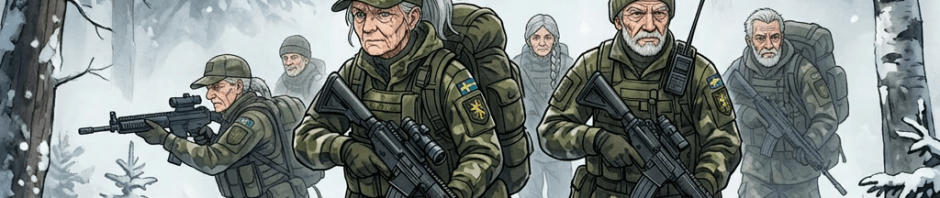
The international press has recently been captivated by a striking figure: one million. With Finland’s latest legislative shift to raise the reservist age limit to 65, headlines across the globe are painting a picture of a nation arming every citizen from the cradle to the doorstep of retirement. But if you strip away the media hype and the strategic signaling, the truth is far more surgical, professional, and—honestly—more interesting.
The Legislative “Hunting License”
To understand the expansion, you have to understand the rigidity of Finnish law. The Defence Forces cannot simply pass a decree that says, “We’re keeping these 500 specific logistical geniuses and elite operational planners.” To be legally sound, the law must apply to the entire cohort.
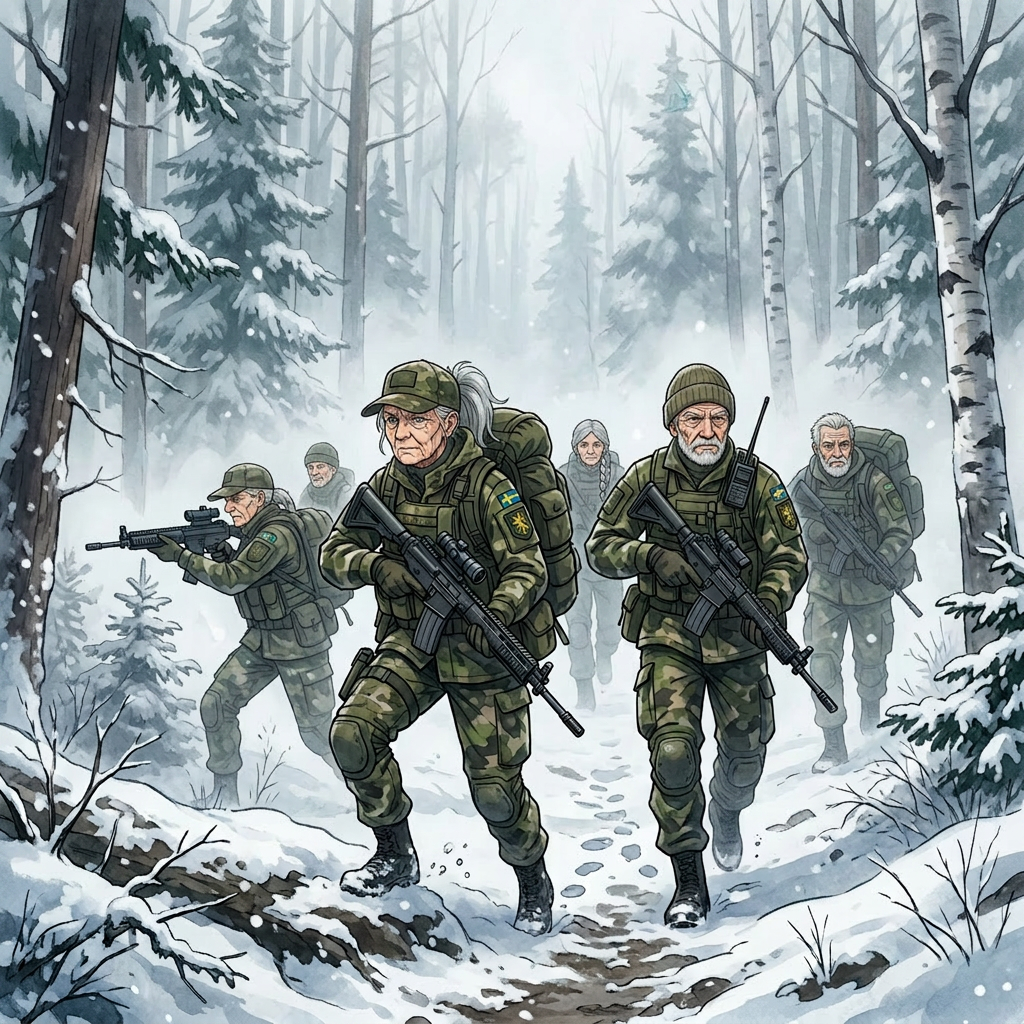
By raising the age limit for the entire reserve to 65, the military isn’t looking to fill front-line foxholes with grandfathers. Instead, they are securing a legal “hunting license” to retain the “Staff Ninjas”—the men and women with decades of silent knowledge who know exactly how to move a brigade, manage a NATO-integrated supply chain, or read a complex situational map under fire.
The 85–95% Reality
The math of the Finnish defense is unique in the Western world. While our allies often rely on professional “standing armies,” the Finnish local battalion is a reservist machine. Depending on the summoning bracket, a unit is typically staffed 85% to 95% by reservists.
The distribution of professional soldiers (Regulars) follows a sharp gradient:
- Echelons 1–4 (High Readiness): These units have a higher concentration of professionals to ensure an immediate, high-tech response.
- Echelons 5–9 (The Mass): As the echelons move toward territorial defense, the professional presence drops.
In these lower brackets, the unit’s effectiveness relies entirely on its “brain”—the leadership and specialized experts. By extending the age limit, Finland ensures that this “brain” doesn’t legally evaporate due to retirement exactly when a crisis hits.
A Beacon of “Total Defence”
Internationally, this move has solidified Finland’s reputation as a “Ready Nation.” While other NATO members are scrambling to reinvent conscription or rebuild gutted reserves, Finland is simply fine-tuning a machine that never stopped running.
The world doesn’t see the bureaucratic nuance of age-bracket adjustments; they see a nation of 5.5 million people capable of surging a force that rivals the largest powers in Europe. It is a pragmatic, cold-blooded insurance policy: we have the rifles, we have the strongest artillery in Western Europe, and now, we have legally ensured we keep the veteran minds needed to lead them.
The Shadow of Runeberg and Topelius: The Romantic Trap of the “Sotavanhus”
In the literature of J.L. Runeberg (The Tales of Ensign Stål) and Zachris Topelius (The Tales of a Barber-Surgeon), the “sotavanhus” is a mythical archetype. He is the grizzled veteran—scarred, stoic, and often impoverished—living in a humble cottage (sotilastorppa) after decades of serving the Swedish Crown.
- Runeberg’s Perspective: To Runeberg, the sotavanhus (like Ensign Stål himself) is the keeper of national honor. He is the man who outlived the wars of 1808-1809, carrying the “silent knowledge” of defeat and heroism. He represents a tragic, noble end: a soldier who has given everything and now sits by the fire, a living monument to a bygone era.
- Topelius’s Perspective: In his historical sagas, the sotavanhus is the link between generations. He is the “old fox” of the Thirty Years’ War or the Great Northern War, a man whose body is broken but whose spirit is forged in Prussian-style discipline. He is the grandfather who teaches the next generation that “to live is to serve the Fatherland.”
The Point: Why We Are NOT Creating Runebergian “Sotavanhukset”
While the 65-year age limit expansion sounds like it’s calling back to these old veterans, the strategic intent is the exact opposite of the romanticized “old man by the fire.”
- From Monument to Mechanism: Runeberg’s sotavanhus was a historical artifact; he was “retired” from the machine. The modern 65-year-old reservist is a functional gear in the machine. We aren’t keeping them around for the sake of “honor” or “tradition”—we are keeping them because they are operationally indispensable.
- Avoiding the “Broken Veteran” Trope: The sotavanhukset of the 1800s were often physically spent and socially discarded. The modern expansion is built on the fact that today’s 60-year-old is often at the peak of their professional and cognitive capability. We aren’t looking for broken men; we are looking for intact expertise.
- Active Service vs. Passive Memory: In the Finnish classics, the sotavanhus is someone you go to for a story. In the modern FDF, the “Staff Ninja” is someone you go to for a solution. They aren’t there to reminisce about the past; they are there to engineer the future of the 5th through 9th echelons.
- No More “Sotilastorppa”: The old system relied on a warrior class that lived and died by the sword. The modern reserve system relies on the integrated citizen-specialist. By staying in the reserve until 65, the modern expert bridges the gap between high-level civilian professional life (IT, logistics, engineering) and military command.
The Bottom Line
We are reclaiming the sotavanhus from the pages of 19th-century poetry and putting him back into the esikunta (staff) office.
The goal isn’t to create a class of elderly warriors waiting for a heroic death like Sven Dufva. The goal is to ensure that the intellectual capital of the defense force doesn’t have a mandatory expiration date. We are taking the discipline of the “old Prussian” and the loyalty of the “Runebergian veteran,” but we are stripping away the tragedy and replacing it with high-tech, operational utility.
Sources & Further Reading
- Reuters: Finland ends era of non-alignment, moves to expand reserve capacity (Search: Finland NATO reserve age limit)
- Anadolu Agency: Finland to increase upper age limit for reservists to 65
- The Straits Times: Finland raises reservist age to 65 to strengthen NATO’s northern flank
- Atlantic Council: The Finnish Model: Why Finland’s reserve is a blueprint for NATO
- Finnish Government (Valtioneuvosto): Legislative amendments regarding the North Atlantic Treaty Organization (NATO)


