IsoT Leffassa, Spooks:the greater good

rsz_spooks1_resizedpsfqijizcwlebsu6wjhvVuokrasin leffan Googlen kapupasta. Mutta elokuva on nyt myös netflixissä nimellä MI5.

 Jos tykkäsit aikoinaan MTV:llä, ja sitä ennen kaksi kautta ylellä pyörineesta BBC sarjasta “Erikoisjoukkue” alkuperäiseltä nimeltään Spooks, pidät myös sarjan jatkoksi tehdystä elokuvasta. Tarina kertoo kuinka Harry Pearce joutuu estämään terrori-iskujen sarjaa Lontoossa ja samalla etsimään petturia omista joukoista. Aika toistuva teema sarjasta siis. En kylläkään epäile eikö vakoojien maailma ole melko paranoidi petturien etsintöineen, AINOA todistehan on jos joku saadaan kiinni. Se että mitään epähygieenistä ei löydy, todistaa vain että se on kätketty hyvin.

Leffa ja sarja kertovat MI5:den eli Security Servicen taistelusta sekä kotoperäisiä että ulkomaisia uhkia vastaan pääasiassa Lontoossa ja Etelä-Englannissa, mutta sarjassa piipahdellaan myös muissa maissa ja maanosissa. Sarjassa piipahti usein muitakin brittikuuluisuuksia, kuten vaikkapa Hugh Laurie. Sarja myös vaihtoi näyttelijöitä usein, ja oikeastaan Peter Firth eli Harry Pearce on ollut mukana alusta asti. Myös Malcolm Wynn-Jones (Hugh Simon) tekee pienen roolin leffassa, ja siis oli myös mukana koko sarjan tuotannon ajan. Eli vaikuttaa että kovin ns staying power on keski-ikäisillä valkoisilla miehillä, jolla on substanssia ja substanssiosaamista, eikä vai “muodollista pätevyyttä”. 8)

Saattaa tietenkin vain olla, että pidän kovista keski-ikäisistä jannuista, siis todellisista äijistä, kuten Valtaistuinpelin Tywin Lannister (Charles Dance ), ja Spooksin Harry Pearce. (Ehkä haluaisin olla semmoinen itsekin.) Nuorelle polville sankarina leffassa on Kit Harrison, eli Valtaistuinpelin John Nietos, Vartion johtaja, ja mahdollisesti Talvivaaran tuleva herra.

Spooks:the greater good ei ole semmoinen elokuva, että sen katsoisi heti pariin kolmeen kertaan, mutta aivan ainakin kertakatsomisen arvoinen. Google shop vuokraa elokuvaa Suomessa 2,99€ alkaen. Ei ollenkaan samanlaista vakoojafilmiä kuin vaikka pappi, lukkari talonpoika vakooja, joka on samantapaisten ongelmien kanssa painiskelava kylmän sodan leffa. Kehota katsomaan samannimisen tv-sarjan 70-luvulta. Oikeastaan melkein kaikki Le Carren kirjat ja filmatisoinnit ovat erittäin hyviä “oikeita” vakoilu romaaneja, toisinkuin “007 seikkailut product placement” maailmassa. NOH olihan alkuajan bonditkin aika rautaa..

Posted in Elokuvat | Tagged | Leave a comment

A hybrid warfare center is needed,will come operational in 2017

Finnish minister of Defense Dr. Jussi Niinistö announced today that Finland will set up a hybrid warfare center in 2017, and invites NBP9 countries to join in. This center is goingo to concentrate on “gray area power plays” and hybridwarfare, as waged now a days by Russian Government. (Link HERE in Finnish)

Finnish authorities got a sample of Russian chutzpah last weekend when a couple of Russian diplomats snatched three children from children safety officials in Seinäjoki, and transported them to Russian embassy in Helsinki. There has not been anything in mainstream news, which might indicate a cover up or finlandization in practice. This is of course embarrassing, as police was there but would not stop CD marked cars.

Two Finnish born Russian propaganda warriors Mr Backman and Janitskin were gleeful about the supposed heroics done by diplo service. As I mentioned this happenstance has not been mentioned in MS media, which might indicate that officials cannot talk, since they would be discussing a certain case, or in general somebody is trying to keep things under lids.

Mr Janitckin the head of Donbass broadcasting corporation is under examination by the police and the police would like to have him arrested. District court has not yet given the a apprehension order.

Interesting times we live in…

Posted in hybridisota, informaatiosota, sisäinen turvallisuus, Suomi ja Ruotsi, voimapolitiikka | Tagged , , | Leave a comment

IRST tulevan ilmasodan todennäköisesti tärkein sensori.

Kaikilla lentokoneilla on mahdollisuus valita laittaako tutka päälle vai ei, mutta moottori täytyy olla päällä jos haluaa lentää. Tähän oikeastaan tiivistyy IRSTn tärkeyden ydin: Lämpösensori havaitsee lämpöä, lentävän koneen moottori käy, moottori tuottaa lämpöä eli lämpösensori havaitsee lentäviä koneita. Aika yliyksinkertaisesti sanottu, mutta kutakuinkin noin. Ja mitä enemmän töitä tehdään (kovempaa lennetään tai enemmän kannetaan), sitä kuumempaa kaikki on, ja sitä kauempaa kaikki on havaittavissa.

Koneen lämpöjälki on yksi osa koneen häiveominaisuutta. Yleensä, kun häivekoneista puhutaan, tarkoitetaan koneita, jotka on muotoiltu siten että ne ovat mahdollisimman hankalasti tutkassa havaittavia, tai ainakin JONKUN AALLONPITUUS ALUEEN tutkaissa vaikeammin havaittavia. Esimerkkinä vaikkapa nykytytkat jotka toimivat reippaasti yli gigahertzin taajuuksilla: Häivekoneet, kuten vaikkapa F-22 on suunniteltu toimimaan juuri näitä alueita vastaan. Toisen maailmansodan Saksan tutkakompleksi, suomalaisilta nimiltään Raija (Freya), Riitta (Würzburg-Riese) ja Irja (Würzburg-Dora), sensijaan havaitsisivat myös F-22 koneen aika näppärästi. Tosin edellämainittujen tutkien toimintaetäisyydet olivat niin lyhyet, että ne olisivat toki hyvin helppoja joko tuhota tai väistää. Edelleen koneen häiveominaisuuksia ovat näkyvän valon alue, infrapuna, eli lämpösäteily, sekä UV säteilyn alue.

Kuva hävittäjästä flir.eu sivulta. Veikkaan että merta vasten, koska koko tausta on tasaisen tummaa.

Näkyvän valon alueella toimii luonnollisesti suojavärityksen, eli ilmaherruusharmaan, ja koneen fyysisen koon yhtälö: mitä parempi väri ja pienempi kone sitä vaikeampaa se on havaita optisesti. Lämpösäteilyllä yhtälöön tulevat mukaan nopeus jolla liikutaan, ilman kitka kuumentaa siiven etureunoja sekä nokkaa. Mitä kovempaa liikutaan, sitä kuumempaa siellä nokassa on, ja sitä kauemmas luonnollisesti myös lämpöjälki näkyy. kantamisen määrä ei sinänsä aiheuta suurempaa kuumuutta, joskin moottorin täytyy tehdä enemmän töitä ilmanvastusta vastaan, mutta koneen optinen koko kasvaa ja lämpöjälki tulee hieman viileämmäksi mutta suuremmaksi.

Infrapuna systeemit olivat melko laajasti käytössä vietnamin sodan ajan koneilla, mutta tutkien kehittyessä niistä luovuttiin. Esimerkiksi C/D gripenillä tai F/A-18 Hornetilla ei IRST järjestelmää ollut. Se voitiin lisätä laittamalla maalinosoituspodi kiinni koneeseen. Sama trendi oli muillakin mailla. Kun tutkahäiveominaisuudet nousivat 1980-90- luvuilla keskeisiksi, IRSTllä alkoi uusi elämä. IRST on passiivinen systeemi, joka on kehittynyt niin plajon, että sillä voidaan nykyään jo ampua myös ohjuksia. Vietnamissa se antoi varoituksen että lämpölähteitä oli kantamalla. ja jonkinmoisen arvion suunasta.

Nappasin kuvan FLIR.EU sivulta. Kyseinen puulaaki valmistaa IR array nimisiä osia. Suomenkielinen nimi lienee infrapunamatriisi. Käytännössä samantapainen piiri kuin vaikka kännykän kamerassa, mutta huomattavasti pienemmällä resoluutiolla. Nykystandardi on 512×640 pikseliä. (Lisää aiheesta voit lukaista kolmannella kotimaisella TÄÄLTÄ) Ilmeisesti tuo 512×640 osa on juuri se, joka tulee olemaan HX-ohjelman kaikilla koneilla nokassaan, Rafalen FSO sensorissa on vielä sukupolvea aikaisempi 320 vaakapikselin matriisi, mutta uudessa FSO sensorisysteemissä se tulee olemaan sama 640 matriisi kuin muillakin. Eurofighterillä, joka on jonkinverran tuoreempi kone, on alusta asti ollut tarkempi matriisi systeemissään.

IRST, infrared search and track, sensori tulee olmaan sama kaikille HX-kandidaateille. Kun vielä kaikille HX kandidaateille on käytössä aikalailla samankaltaiset litening (maamaali) podit, joka on asiasta toiseen myös horneteilla käytössä, ei tällä systeemillä oikein eroa eri HX kandidaattien välille saada. Ainoa jolla on merkitystä on sensorin optiikka, sensori on sama kaikilla, ja en jaksa uskoa että 2010 luvulla kukaan enää sössii sopivan linssin valmistusta. 

Posted in elektroniikka, HX-ohjelma, ilmavoimat, Optiikka, teknologia | Tagged , , , , , , , | Leave a comment

Böker Magnum Persian Fighter, good EDC knife on the cheap side.

dsc_0536

I decided to get a BÖKER MAGNUM series Persian Fighter as a cheapish EDC carry knife. The  knife does not give out “cheap and shittily made” wibe at all, but it’s relative austerity comes from the steel that was used. It is not the “most bestest” steel but tried and true 440 stainless steel. There ARE harder, more durable, more edge holding and more stainless steels around, but 440 is a good average somewhat inexpensive steel that is well known and understood in metalworking. My example came from Teräasekeskus, a knife and arms store in Finland. They have pages in English as well, if you want to take a peek.

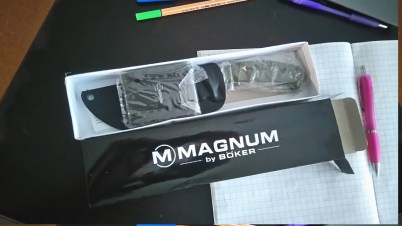
The packing of the knife was nothing to shout about: a plastic wrapped cardboard box, where the “dinge an sich” was wrapped in somedsc_0537 more plastic. This ought to give you a good idea of the size of the thing. The overall lenght is in neighbourhood of 24,5cm.(9 3/4 in archaic) The blade is about 12cm (4 3/4 inch) in length.  The knife has a drop point and the back of the blade is just lightened, it is not sharpened. The handle is curved and quite thin, for my size 10 hand. I think it is great for somewhat smaller hand. there is always possibility to add some more material, plastic or possibly fabric, under the G-10 handles to make the handle a bit thicker. Closest part of the blade is in 90 degrees edge in the back and works well with flint in lighting fires. The handle is curved and maybe a bit tight for my aforementioned paws, but in no way awkward to handle. This type of handle works great for fighting knives, as it fits well into the crook of fingers. On the down side it is not as good in woodworking: It does not sit as well in hand. the handle IS curved, so unless extra flexible hand bones you just cannot wrap your hand around the hilt. OR maybe it is again my 10 size hand.

The knife is well balanced in a positive way heavy. This gives sort of “reliable” feel to whole contraption, not to mention extra strength if you have to use the glass-breaker in the pommel.

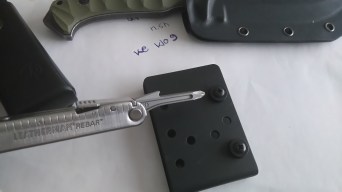
The sheath is kydex as is the belt loop. Atractive feature for me was the mounting of the belt loop: It can be screwed on both sides to make the knife better able to be mounted either for leftie or right hand cardsc_0540ry. I usually carry my Persian fighter in small of my back in the right side. (in well concealed, but easily accessible place) in summer times. Wither might be a different story.  As you can see there are myriads of carry options available. The sheath locks very firmly into the place, so you don’t have to worry about dropping the knife f

dsc_0539

rom the sheath. The belt clip can also be adjusted easily to different broadnesses of belt, so you can always have a pretty snug and  unwobbly platform at your disposal.

The blade is OK out of the box, and if the knife is carried for the odd cardboard box or similar tasks the sharpness is not of the premium importance, but there is possibility of cutting flesh or wood I do recommend a proper (hand) sharpening to be done.

BÖKER MAGNUM Persian Fighter gives good value for the money. Design is impeccable, knife is not overly large, and will serve you well as your EDC carry knife come hell or high tide.


Posted in varustearvostelut, Varusteet | Tagged , , , , , , | Leave a comment

Finland stepping up wartime strenghts?

Minister of Defense Dr Jussi Niinistö said today in paper Verkkouutiset Nykypäivä that Finland will be seriously looking into upping wartime strenghts to where they used to be. Also Finland might Revise the Ottawa Treaty, that hampers national defense disproportionally. Finlands wartime strenght is currently 230 000 men, but might be going back to 350 000 soon. Goverment feels that austerity programs have gone too far into national security.

Posted in armeija, Armeija 2020, puolustusvoimauudistus, Sodanajan joukot, Uncategorized | Leave a comment

Euro-canards going head to head: a bit of pros and cons.

HX-program is still on the works, and so are the speculaations of “what should we pick” is in its infant stages. In order to get some kind of an idea how Eurofighter Typhoon, SAAB Gripen and Dassault Rafale compare among themselves I have been doing a bit of reading: Obviously these planes have not gone head to head in anger, but in practice. Lastly in Tigermeet 2016, but the have taken part in same campaign: Libya 2011. In Libya 5 years ago only Rafale was “quite ready” platform. (Typhoon is still a bit of a development progress, and Gripen was C/D configuration, so not yet the E/F that Finland is considering in HX-program.) But obviously all three eurocanards are being developed constantly. Also obviously everything written here is to be taken with a quite a bit of salt. I am reading official sanitized reports.

Also one has to keep in mins, that even though all aforementioned fighters are multi(or swing- or omni)role, they have been optimized for one thing: Eurofighter as an air superiority fighter from land-bases, Rafale as a carrier capable strike fighter and Gripen as cost-effective light fighter. So each and all can do all the things, but they can do some aspects of task a bit better than the competition.

Only distinct difference is in IRST modules of the planes: Gripen and Typhoon use newer FLIR IR array that giver them a better resolution compared to Rafale’s FSO system, BUT Rafales is upgrading to FSO II system, that will have precisely the same array and capabilities (IF there is not significant size difference in optics side of things). Laws of physics are the same for all.

But As I mentioned I have done some reading in Libyan air war of 2011 (brits call it operation Ellamy, the French call it Harmattan, and Swedes might call it something else, but I dont know what.) The Typhoon and Rafale have of course since taken part in operations in Syria, Iraq, Afganistan and Mali. So one can expect them to perform quite adequately in combat.

All mentioned planes gave good combat performance, but as their usages were quite different, it is impossible to say which might be the “best” plane of them. Gripen did mostly tactical recce, Typhoon mostly flew Combat air patrol, and Rafale did a lot of strikes, with other duties thrown in.

RAND report gives a nice rundown of the campaigns. You can download a full report there, but as my main concern are performance of named fighters, it is not completely useful for this purpose, but is an enlightening read never the less. If you want a quick version HERE is wikipedia’s version of it.

French operation (Harmattan) did not conclusively prove that Rafale can survive in hostile airspace without of support of SEAD/DEAD platforms. This is not true: Italy’s Tornados and US F-16CJs DID SEAD in the early part of campaign as dedicated NATO SEAD platform. (The allies wanted to play it safe, and assumed that Libya had competent and functioning integrated air defense system. This was not the case) I do not doubt that Spectra is a good system, but I just cannot believe that it can singlehandedly do away an integrated air defense system. Even though Rafale flew DEAD missions in Libya, but against maybe fourth stringers, or their backups,  still gives serious doubt about the capabilities of SPECTRA against 1st string integrated air defense system. I feel dedicated SEAD/DEAD platform needs to exist for Rafale as well. This is not Mali, this is Finland.

EuroCanardOminaisuudetI have collected some hard data on three eurocanards and F/A-18 E as a bit of a comparison. Some info about JAS-39 E is not yet available. These are marked with ? and + usually meaning that the figures are in that neighborhood, and somewhat above that (as the data was taken from C/D model Gripen) What is interesting to see is how well the numbers reflect the are of the optimization for each respective plane: Awesome load for strike-fighter optimized Rafale, Excellent speed, power to weight ratio and service ceiling for Air superiority fighter oriented Typhoon, and price and takeoff and landing runway lengths for dispersion specialist JAS-39 Gripen. One hast to mention the fact that Rafales need for runway is mere 450m, without using braking chute. and Armee del Air has operated in rather austere facilities in Mali and thereabouts. So Rafale is indeed the Gripen’s worst competition (in IMHO) in HX program.

@gripennews pointed out to me, that in Brasilian evaluation they had give both Gripen’s and Rafale’s air-to-air range as 1700km. I’ll update it here. But I would like to point out that as 1.9.2016 I do not know that Gripen E has flown, so there still is a lot of speculation going about. We’ll see in year or two.

The speed and ceiling advantage is significant, as greater speed at launch and greater launch height allow missiles to be fired much further out, giving who ever is higher a clear advantage in missile performance.Approximately 50% going from 15km to 19km. If missile has range of say 100km in 15km, it should have a range of about 150km in 19km. (Of course you STILL have to pick out the enemy in 150km and be able to target it, to get full benefit.) And as the announced ranges, maybe it is more accurate to say that the range drops from. Buyers beware and all that. Ceiling is the same for Rafale and Gripen, Gripen is a bit speedier of the two, so it should hold a slight advantage in missile range (missiles will be, at least in a couple of years, the same, Meteor, for all three).

Rafale will carry awfully lot of luggage. Her engines are the “weakest” on max military power, but this on the other hand causes them to be coolest of the lot, this means they are harder to pick with IRST, and Rafales power to weight ratio is still excellent. (in clean configuration all eurocanards enjoy P/W ratio of over one, but after they are loaded the figure drops under 1 a bit.) Rafale has a new wing in the planning to reduce drag, so we may well see better speed with maybe a bit less carrying capacity in HX-fighters

SAAB Gripen is visioned as the cheapest of the lot, and it certainly has the lowest operating cost. One engine just uses half of the juice of two. Turbines are funny in the way they use about the same amount of gas idling than in full tilt. So you don’t get benefit of running two engines “in idle” compared to one in full revs. Also comparing the capabilities of eurocanards, the difference between expensive and cheap aircraft is not very great. Comparing the leading edge of the tech to 5 years old in capabilities say in computing are pretty much nothing today: electricity in copper wire can not go any faster than it does. Gone are the days when computing power doubled every 18 months. That is why now a days only way to speed up the processing is to build an array of processors or computers. Two processors in computer means it is about 1,5 times faster than one similar processor on its own. Everybody knows how to do this, so 3 times more pricey might mean just 50% of more power. And considering that we are talking about systems that there is a human in the loop, you just cannot go faster than a human can react. (yes, there are automated systems in planes and flying, but combat drones are still about 10-20 years away in west).

One football coach used to say that there is safety in numbers, and Napoleon put it that the God is on side of greater battalions, meaning that one superior fighter will get defeated by more numerous inferior fighters. So even though four a bit lesser fighters cost as much to buy and operate than two great fighters, they will still most likely be victorious against the great fighters if other elements are about the same.

Typhoon is the plane of choice for Air to Air war: outstanding sensor suite, speed and ceiling in abundance reasonable carrying capacity and excellent combat range in AA configuration. It may just be the weakest in air to ground role. It has the carrying capacity, but her capabilities are just now maturing. Typhoon HAS dropped bombs in anger, but in Irak, so the survivability in top notch air defense system is still a question mark.

These planes are expected to fly in Finnish atmospheric conditions, so presence of moisture will be a very limiting factor of what the fighter systems CAN detect in first place, so networking capabilities of the fighters are more important that capabilities of their own systems alone. And all these fighters have at least the standard NATO-16 data links.


 

Posted in Baltic situation, HX-ohjelma, ilmavoimat | Tagged , , , | Leave a comment

REBLOG: National Interest, Finland USA’s new ally?

I found an interesting piece in National Interest. Link to original HERE. This covers Finnish position in North-European gameboard exactly.  In Finland there is childlike believe that Finland can stay out of any future NATO-Russia confrontation, even though both parties in conflict would like to use Finnish sea- and airspace in their operations. So BEST we can hope for is guarded neutrality with extreme prejudice. 

The famously neutral nation fears Russian aggression.
Michael Peck
August 28, 2016

“Finlandization” is the term for a small nation, located next to a much bigger nation, that maintains a foreign policy of careful neutrality. In return, its bigger neighbor doesn’t crush it.

Can you guess which country Finlandization is named after? Good guess! Having your country become a synonym for neutrality isn’t exactly a compliment, but if national survival is a worthy achievement, then Finlandization has worked for Finland for almost a century. Despite being on Russia’s northern border and losing two wars with the Soviet Union in 1939–40 and 1941–44, Finland has remained independent and democratic.

No, Finland could not join NATO (nor did it even join the European Union until 1995, after the dissolution of the Soviet Union.) Yet even if its choices were constrained by the Muscovite behemoth to the south, at least Finland had a freedom of choice that the Poles, Czechs and Hungarians could only envy during the Cold War.

But is Finland about to abandon neutrality and become America’s newest Nordic ally?

Finnish Defense Minister Jussi Niinisto told Reuters on Monday that his nation is negotiating a defense agreement with the United States. Niinisto expects the agreement to be signed by this fall.

Niinisto said the agreement would not include any military obligations for either nation. “It would cover areas where we already work together, like military training, information sharing and research,” he told Reuters.

Sweden—also another Scandinavian bastion of neutrality—signed a similar agreement with the United States in June for collaboration on antisubmarine and antiair warfare. Both Finland and Sweden attended a NATO summit meeting in July. Though it’s worth pointing out that unlike Finland, Sweden doesn’t share a border with Russia, hasn’t fought a war with Russia since 1809, and never appeared on any atlas as a part of the Tsarist Empire.

Predictably, Russian President Vladimir Putin responded that if Finland joined NATO, he would move troops to the Finnish-Russian border. “Do you think we will continue to act in the same manner [if Finland joins NATO]? We have withdrawn our troops 1,500 [kilometers from the border]. Do you think they will stay there?” he asked reporters. No, we don’t expect Russian troops to stay where they are. We do expect them to move closer to the Finnish border, but not cross it. Grabbing Crimea from Ukraine, or supporting a disgruntled Russian minority in eastern Ukraine, is one thing. Invading or destabilizing Finland is something else.

This 1500km from the border had a life of it’s own. There was much debate about WHAT did mister P. mean with this 1500km from border? Because Alakurtti is something about 50km from border. So are various places in Karelian peninsula and Kola. Also St. Petersburg and Pskov and Kaliningrad are within the 1500km circle. Of course there was a much debate about could mr P. lie deliberately? or had he the facts wrong? Appeasers were of course ready to believe Putin, and were ready to condemn naysayers for damaging relationships to foreign power. I could not really believe what I read and heard. Epämuodikkaitaajatuksia on 31.8.2016

Which raises the question: why is Finland seeking closer military ties with the West?
The obvious answer is that Finland and Sweden are worried. Russian intervention in Ukraine, Moscow’s rumblings toward the Baltic states, and Russian violations of Finnish and Swedish airspace have them on edge.

I contacted Mika Aaltola, who directs the Global Security program at the Finnish Institute of International Affairs. Aaltola says that while Finns “have a deep distrust that formal alliances work,” the Finnish government is interested in a bilateral relationship with the United States because of an “acute awareness that national interests match. This is thought to be a very solid basis for a deepening partnership.”

From the U.S. perspective, Sweden, and to a lesser extent Finland, are needed to defend the Baltic states from Russia. “What is needed from Finland, is for Finland to be able to stop the Russian use of its airspace and maritime areas to support military incursions into the Baltic,” Aaltola says. For the Finns, the incentive for closer ties with the Americans is the need to secure its trade routes. “Finnish arteries are along the Baltic sea,” he adds.

However, Aaltola doesn’t see this as “so much a step towards NATO, although it might be that Finland will join in five to ten years. It is more a move to consolidate the Finnish position.”

Nonetheless, the question still remains as to what Finland will get out of antagonizing Russia. Unlike Finland, America doesn’t share an 800-mile-long border with a nuclear-armed and somewhat touchy former superpower. Closer ties with the West haven’t saved Ukraine, and it’s debatable whether they’ll save the Baltic states. Would the United States or NATO commit aircraft or ships—let alone ground troops—to Finland’s defense? And under what circumstances, given that Russia has mastered the art of attacking or threatening its neighbors through means short of outright war? Even Sweden, which sent volunteers and supplies to aid the Finns in the Winter War of 1939–40, never formally went to Finland’s defense.

As the Finns learned in the Winter War, the world will denounce aggression while not doing anything about it.

Michael Peck is a contributing writer for the National Interest. He can be found on Twitter and Facebook.


Posted in Baltic situation, NATO keskustelu, Suomi ja Ruotsi, Suuri peli, TurPo, uhka-arvio | 2 Comments

Kesäkiireitä, or Summer Is A Busy Time

Vaikka olisi kieltämättä halua kirjoitella TurPo aiheista, ja on loma ja kaikki, niin R:va Epämuodikkaita on laittanut minut puutarhahommiin.

Even though one is waiting to get something typed has The Mistress Epämuodikkaita me toiling in the garden with a showel. One is confident that I get something written before August.

Posted in henk.koht, Uncategorized | Leave a comment

“Instant refreshments training” begin in FDF

As 1st July onwards any reservist in Finland can be called up on “instant notice”, untill this reservists were required to have at least three months of prior notice. This will of course be the regular case from this on as well, but “instant recalls” are meant to be as a way of countering hybrid warfare and as a flexible response tool for heightening security threats in Finland or around Baltic.

Posted in hybridisota, Reserviläiset | Tagged , , | Leave a comment

Tour de Sky 2016 in Kuopio Rissala

Last weekend in 18th and 19th of June we had in Corfu Tour de ski 2016 all the major participants in 8X program where they are to one degree or another.  I had the pleasure to be invited into Tour de Sky 2016 By SAAB on Friday. I got to meet and talk with Jan, Magnus and Gideon from the  SAAB Gripen program.  The SAAB gentlemen were very patient with me asking  unfashionable and indescreet questions considering the use of stealth and other things in Gripen program that interest me.

One thing I had in mind was that as they have lengthened the Gripen E’s body and increased her takeoff weight have they also increased the area of the wing? Yes they have, but the wing loading is a bit bigger than with Gripen C/D. But the increase is not dramatic.  Will there be a Gripen Growler? Will the jamming capabilities be provided by Swedish or some other party? and so forth. But more of this later.

One thing that really struck me in the Kuopio Rissala Airfield was the difference in size between the EUrofighter and Gripen. When we get to see and ogle around the aeroplanes and see their size, Gripen D’s air speed meter in the nose of the plane was about the same level as my belly button, so Gripen is  indeed a small plane.

This enhances her capabilities as a “close in” or WVR fighter because smaller plane is self-evidently much harder to see using just your eyeballs, to get the other plane and to get into the firing position. Swedish pilot giving us a briefing about the Gripen told about this when they have a common practices with the Finnish air force F/A-18 C Hornets. So one might say Gripen is the stealthiest plane of all the HX candidates in WVR and visual light spectrum.

Mrs. Natalie Bakhos from the Dassault Rafale was very kind to me and forthcoming with information about the about the the Rafale program and Rafale for Finland. Dassault had a really nice Pavillion to display on Rafale. But unfortunately there was not a plane itself. But there was a sizeable team of people anwering questions and telling about the fighter, so I had thoroughly nice time with the Rafale team. They also had good selection of goodies for friday, and geve me a photo CD I’ll be putting photos from to this site anytime soonish.  Waffle House it quite plain that they have succeeded in making ruffle very cold airplane.  it is maybe the hardest of the whole bunch to detect on IRST,  or in infrared Spectrum anyway.  but I do have my misgivings over will be Spectra system be sufficient in protecting me cut off all fighters in Finish air war situations where good air defense systems and good Fighters a bound. So I’d like to see some kind of a wild weasel or Growler variant over Dassault Rafale.  But this might just be me.

British Aerospace or BAE also had Pavillion in place right acroos SAAB’s and they also had two Eurofighter Typhoons on display outside so that one could go around and see the planes close at hand. Two eurofighters present were RAF. The pavillion was not yet in full swing in friday, but I got to meet the team there.

Lockheed Martin had a really nice tent with the really really nice this place in the air show.  the good gentleman from there locate Martin even called me and asked me if I want to book that flight simulator time which I have caused it and I would have even had it cost me arm and a leg and one child.  Mr. Gary North had a good informative talk and presentation with me and we discussed in some length the problems posed on Finnish Air Force by S-300 S-400 and future S-500 missile systems or let’s say air defense complexes of Russia.  It was people and their it don’t to me that stealth is not yet dead as the Russia and China are both developing their own stealth fighters in PAK-FA and the Chinese rip off of F-35 the The Shenyang J-31

So I even got to fly the F-35 flight simulator in the Lockheed-Martin tent and I thoroughly enjoyed myself flew over they never die in 60 meters and bumps on Airfield before I landed on it and the landing was quite amazing as you can imagine because I, with very little or no,  landing experience managed to to bring the airplane down in one piece.

What really puzzled me was Boeing’s presence, or lack there off. They didn’t even have a booth of their own. They were hardly there at all,hidden behind a booze restaurant in grounds. So I had to start wondering have they decided, that they will not be able to sell the F/A-18E/F/G to Finland, OR are they so sure of it that they do not even make an effort? Your guess is as good as mine.

Posted in HX-ohjelma, ilmavoimat, Jotain aivan muuta, Puolustusvoimat, simulaatio | Tagged , , , , , , , , | Leave a comment