
If you have spent any time browsing NATO defense forums, MilTwitter, or YouTube OSINT channels over the past few weeks, you have almost certainly bumped into dramatic thumbnails featuring F-35s and JAS-39 Gripens banking dramatically over snow-capped peaks in formation.
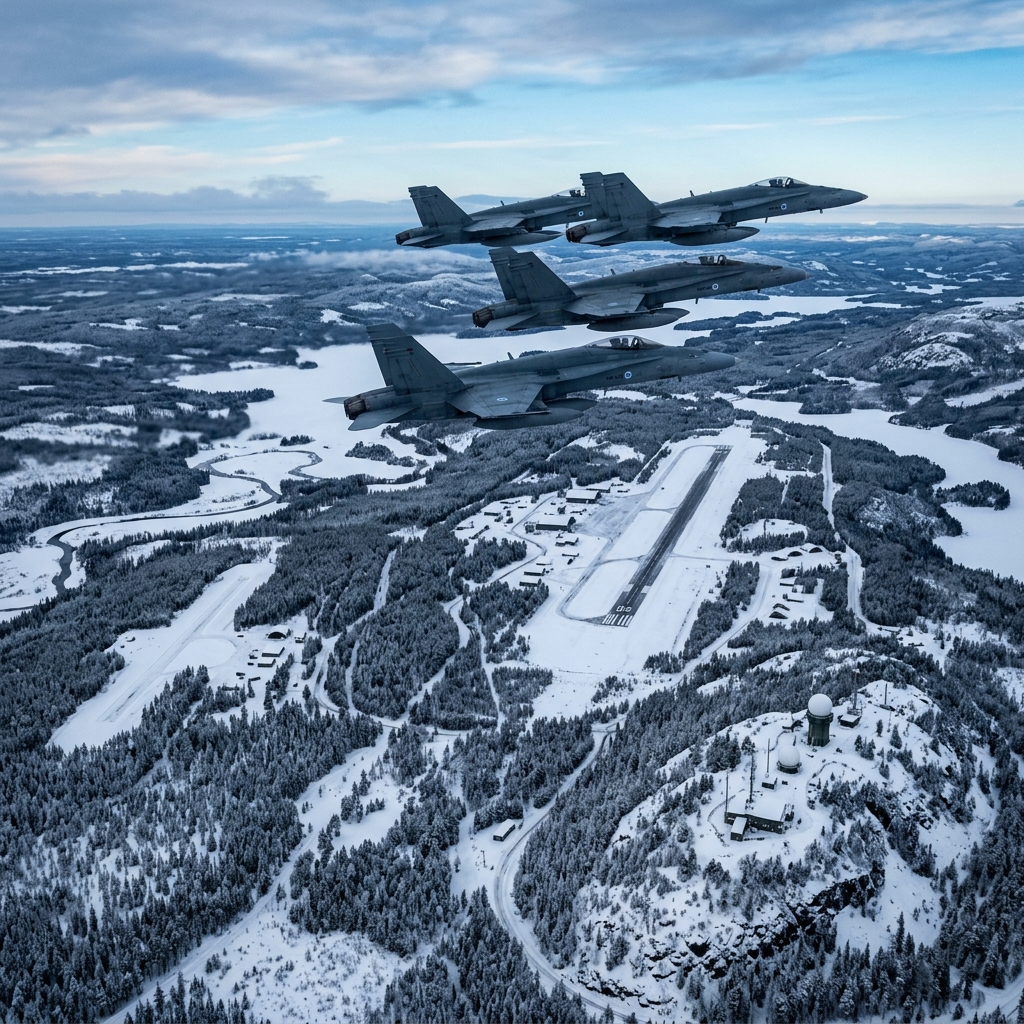
The Western defense commentary machine loves a good narrative. Ever since Stockholm and Helsinki formally integrated into NATO’s Northern Flank, Anglo-American commentators have been practically salivating over what they describe as a “Seamless Baltic Air Wall”—a near-mythical shield where Finnish and Swedish radars merge into a single AI-driven supergrid, sending scrambled fighters intercepting Russian incursions within milliseconds.
It sounds brilliant on paper. It looks even better in a 4K YouTube video set to heavy synthwave music.
The Narrative vs. The Nuts and Bolts
As usual, the international hype train gets the broad strokes right, but misses the operational meat. Outside of Finland and Sweden, much of the NATO blogosphere treats this integration as a sudden, magical transformation brought on purely by signed papers in Brussels.
What the slick NATO promotional reels rarely mention is that Suomen ja Ruotsin ilmatilavalvonnan ja alueellisen koskemattomuuden turvaamisen yhteistyö isn’t a hasty post-2022 patch job. It is the logical culmination of two decades of painstaking, quiet tactical work—specifically the Cross Border Training (CBT) routines that Finnish Hornet and Swedish Gripen pilots have been flying out of Rovaniemi, Luleå, and Bodø since long before anyone in Washington cared to look at a map of the Bothnian Bay.
Since late winter 2026, FAF pilots and ground crews have been working overtime in south-eastern Finland. Temporary flight and maritime restrictions have been imposed practically every week, alongside constant patrolling and scrambles. Such a sustained operational tempo inevitably eats into training capacity and, over time, risks eroding standards. So assistance from the SwAF is more than welcome
When Western defense analysts write about the new agreements allowing Swedish forces—including Gripen detachments, naval assets, and land-based radar nodes—to directly support Finnish Territorial Integrity Surveillance (TVI) and vice versa, they talk about it like a revolutionary strategic leap.
To an operational planner in Tampere or Luleå, however, it’s simply codifying what was already necessary: converting peacetime operational flexibility into legally binding, continuous NATO Integrated Air and Missile Defence (IAMD).
Why the Anglo-American Media Is Obsessed With It
There are three main reasons this joint surveillance framework is currently generating so much noise in English-language defense circles:
- The Tactical Synergy of the Mix (F-35 + Gripen E): Western air power analysts love force-multiplier math. Finland’s ongoing transition to the F-35A brings low-observable sensing and advanced sensor fusion, while Sweden’s GlobalEye AEW&C adds a powerful airborne early-warning and surveillance capability. Combined with Sweden’s Gripen C/E fleet—designed from the outset for dispersed operations from road bases and rapid turnarounds—the Nordic airspace becomes an operational nightmare.
- The “Gray Zone” Problem becomes harder to exploit: International commentators correctly recognize that the Baltic Sea region is currently the world’s primary laboratory for sub-threshold provocation: GPS jamming, unannounced dark-fleet maritime movements, and rogue drone incursions. The joint framework helps close the bureaucratic ‘dead zone’ at the border. A radar track detected off the coast of Vaasa or Haparanda no longer has to wait for a new round of diplomatic clearance; relevant data can be shared across the Gulf of Bothnia in near real time
- Strategic Depth and Dispersion: English-language analysis frequently highlights the sheer landmass of the Nordic region. By treating Finnish and Swedish airspace as a single operational theater, air command can scatter assets across dozens of road bases from Lapland down to Gotland.
The Cold Water: What the Hype Clips Leave Out
While the hype is understandable, realistic military analysis demands we look at the friction points. A 10-minute YouTube video praising Nordic efficiency rarely deals with the unglamorous realities of military integration:
- Data-Link Mechanics and Security: Merging two sovereign air defense picture systems (Ilmatilannekuva) into a near-real-time feed sounds simple until you have to deal with legacy cryptographic standards, NATO Link-16 bandwidth limitations, and national data-handling classifications.
- Targeting and Rules of Engagement (ROE): Identifying a target jointly is one thing; deciding who fires the kinetic interceptor or executes the electronic attack in a complex, ambiguous peacetime incident is another. ROE alignment requires absolute legal precision between Finnish and Swedish defense legislation.
- Sustained Readiness Costs: Running high-tempo radar coverage, continuous fighter scrambles, and joint maritime patrol flights costs money, flight hours, and airframe life. It requires ground crews working in sub-zero conditions at dispersed sites, day in and day out—not just during high-profile NATO exercises like Cold Response.
The Bottom Line
The international defense community is right to be impressed by what Finland and Sweden are building together. It creates a formidable deterrent in Northern Europe that fundamentally alters the calculus for Northern Fleet aviation and Baltic operations. As a side note: when Russia runs its Zapad exercises every other year, one recurring premise in the northern scenarios is that the enemy has achieved air superiority.
However, we shouldn’t let glossy foreign media edits obscure the reality. This isn’t magic, and it isn’t a video game. It is hard-nosed, pragmatic military engineering built by two nations who understand their geography, know their adversary, and have zero time for strategic wishful thinking.


